When someone calls you a 'social bird,' they almost certainly mean you're outgoing, friendly, and comfortable around people. It's a variant of the more established phrase 'social butterfly,' just swapping in 'bird' for the same basic idea: you move easily through social situations, you talk to everyone, and you thrive in company. Whether it lands as a genuine compliment, gentle teasing, or something slightly backhanded depends almost entirely on tone, context, and the relationship between the two people involved. If you're wondering about the time bird meaning, that's usually a separate idea from the slang phrase and may depend on the specific story or tradition you're using.
Social Bird Meaning: What It Says About Someone

Marcus Winters
5 May 2026
What 'social bird' means in everyday English

In everyday conversation, 'social bird' describes a person who is naturally extroverted, sociable, and at ease mixing with different groups of people. It's not a fixed dictionary entry the way 'social butterfly' is, but English speakers borrow that same butterfly logic and attach it to 'bird' because birds also move freely, flock together, and communicate constantly. The meaning transfers almost perfectly.
Cambridge Dictionary defines a social butterfly as someone who likes parties and social events and flits between groups, while Merriam-Webster adds a slight cautionary shade, noting the term can suggest someone 'chiefly occupied with the pursuit of pleasure.' That tension between flattery and mild criticism is exactly what makes 'social bird' interesting: it can be warm praise or a subtle eyebrow raise depending on how it's said. In purely positive contexts, calling someone a social bird is simply saying they're good with people. They strike up conversations easily, they know everyone at a party, and they're the person you bring along when you want the group vibe to work.
One thing worth noting: 'Social Bird' also exists as a proper-noun brand and community name (a Meetup group and similar community platforms use it). So if you stumble across 'Social Bird' capitalized in a digital context, it may have nothing to do with someone's personality and everything to do with a group or app name. That's a quick disambiguation worth keeping in mind.
'Social bird' in slang and texting
In texts and casual online messaging, 'social bird' shows up as a breezy, informal label for someone who's always out, always in the group chat, always at the hangout. The phrase is short, slightly playful, and works well in a message because it carries that bird-in-flight image without needing a long explanation. Someone might text 'you're such a social bird lol' after you've made plans three nights in a row, or 'classic social bird behavior' when you show up at an event you weren't even invited to.
The tricky part with text is that tone cues are stripped away. Research on emoji and texting consistently shows that written messages lose the nonverbal signals we rely on in face-to-face conversation, which is exactly why 'social bird' can land differently depending on what surrounds it. A bird emoji, an exclamation point, or a laughing emoji alongside the phrase usually signals warmth or humor. A dry, flat delivery with no softener can tip it toward teasing or even mild shade. All-caps ('SUCH A SOCIAL BIRD') adds emphasis that could read as impressed or exasperated depending on the rest of the conversation.
There's also a flirty use of the phrase. If someone you've been talking to calls you a social bird, it can be a low-stakes, lightly teasing way of acknowledging that you're popular and fun, which is often flirtatious in subtext. Think of it as a compliment with a small wink built in.
The bird-species angle: which birds actually symbolize being social
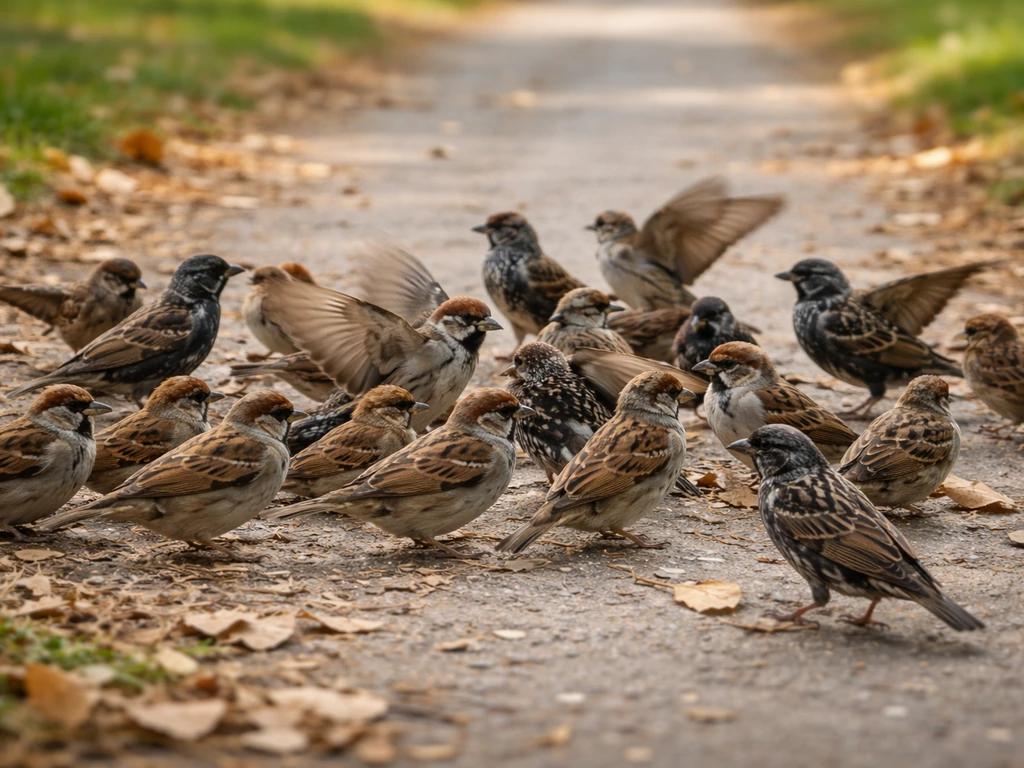
The reason 'bird' works so naturally in phrases about sociability is that many real bird species are genuinely, visibly social animals. Their behavior made the metaphor stick long before anyone consciously invented it.
- Sparrows and starlings: These flock birds are almost never seen alone. Starling murmurations, where thousands move as one fluid shape in the sky, became a natural symbol for collective behavior and community.
- Parrots and parakeets: Parrots are famously communicative, loud, and attention-seeking in the best possible way. Calling someone a parrot can mean they talk a lot; calling them a social bird carries that same energy more gently.
- Caiques and cockatiels: Bird keepers frequently describe caiques as 'highly social' birds that need constant interaction and get depressed without company. The literal animal behavior maps directly onto the figurative human label.
- Pigeons and doves: Historically, pigeons served as literal messengers, and doves appear across cultures as symbols of connection and communication. These birds represent not just sociability but the act of reaching out to others.
- Crows and ravens: In folklore, corvids are seen as highly intelligent social creatures. They form complex relationships, remember faces, and communicate with each other in sophisticated ways, adding a smarter, sharper edge to the 'social bird' image.
No single species owns the 'social bird' label in figurative use. The phrase draws on a general cultural familiarity with birds as creatures that flock, communicate, and move between spaces, rather than pinning the meaning to one specific bird. That flexibility is part of why the phrase works so well as a personality description.
Cultural and symbolic meanings: birds as social and communal symbols
Birds have carried social and communicative symbolism across cultures for thousands of years, which gives 'social bird' a surprisingly deep cultural root even if the modern phrase itself is casual slang.
A 2018 comparative review covering 498 bird species across 123 ethnolinguistic groups found that birds are identified worldwide as messengers, signs, and augurs. Among the Ch'orti' Maya of Guatemala, birds function as the principal bearers of messages about future events, including love, sickness, and rain. The old English expression 'a little bird told me' connects to a folk belief that birds once held the gift of human speech, a remnant of how deeply communication and birds are linked in human culture.
Flock symbolism adds another layer. Across many traditions, a flock of birds represents unity, collective action, and interconnectedness. When a person is called a social bird, they're unconsciously being compared to that flock energy: someone who brings people together, who belongs to the group rather than standing apart from it.
It's also worth noting the Twitter bird here, since for a decade (roughly 2012 to 2023), the blue bird logo was one of the world's most recognized symbols of social communication and public messaging. The phrase 'social bird' carries some of that residual cultural weight, especially in digital contexts, even if the Twitter bird logo was retired when the platform rebranded to X. The association between birds and social posting was culturally reinforced for an entire generation of internet users.
Common contexts and how the phrase actually shows up
Here are the most common situations where you'll encounter 'social bird' used about a person: If you also come across “busy bird” in the same kinds of conversations, the busy bird meaning is usually about someone who is constantly active and occupied.
| Context | How 'social bird' is used | Likely tone |
|---|---|---|
| Texting a friend | 'You're such a social bird, always out somewhere' | Affectionate teasing or genuine admiration |
| At a party or event | 'She's a total social bird, she knows everyone here' | Compliment, sometimes with slight envy |
| Flirting or early dating | 'I didn't know you were such a social bird' | Playful, curious, lightly flirtatious |
| Workplace or group context | 'He's the social bird of the office' | Neutral to positive, describes a connector personality |
| Mild criticism or frustration | 'Of course you're out again, social bird' | Teasing shading into mild annoyance |
| Self-description | 'I'm a bit of a social bird, I get restless at home' | Lighthearted, self-aware, positive |
Example phrases you'll recognize in the wild: 'She's a real social bird, never met a stranger in her life.' 'Stop being such a social bird for five minutes and just sit with me.' 'I didn't expect him to be such a social bird at the conference.' Each one of those shifts slightly in meaning, but the core description stays the same: this person is comfortable with people and actively seeks out social connection.
How to read the tone accurately (and when it might not be a compliment)
The phrase 'social bird' is genuinely positive more often than not. If you're also wondering about “tt bird meaning,” it’s the same general idea of someone being socially outgoing, though the exact sense can shift with the platform and context. But it can carry a backhanded edge in specific situations, and it helps to know how to spot the difference.
Signs it's a straightforward compliment
- Said warmly, face-to-face or with positive emoji in a text
- Used in the context of praising how you handle social situations
- Said by someone who clearly admires your confidence or people skills
- Paired with specific positive observations ('you made everyone feel welcome')
Signs it might be teasing or lightly critical
- Delivered with a smirk, eyeroll, or exasperated sigh
- Said when someone feels you're prioritizing other people over them
- Used sarcastically (flat tone, no warmth, possibly with 'oh' or 'of course' in front of it)
- Implies you're spreading yourself thin across too many social circles without real depth
The backhanded version
The closest the phrase gets to an insult borrows from the Merriam-Webster edge in 'social butterfly': the suggestion that someone is so focused on being social that they're not serious, not committed, or not reliable. Oxford Learner’s Dictionaries defines “blank" rel="noopener noreferrer">social butterfly” as “a person who is not serious and spends a lot of time going to parties, and talking to people.”. If someone says 'you're such a social bird' in a context where you've canceled plans or seem flighty, it may be a polite way of saying you prioritize fun and novelty over depth. This is the same shade of meaning that other bird-label phrases can carry, including some that are genuinely negative (the way 'buzzard' in British English can label someone unpleasant). If you're curious how bird names can shift into judgment in British English, the buzzard bird meaning is a good comparison point. 'Social bird' stays far from that negative end, but the slight critique of shallowness is possible.
What to do when you're not sure
If 'social bird' lands in a way that feels ambiguous, a direct but light response works well: 'Ha, is that a good thing or a bad thing?' Most people will clarify immediately. If you want to use the phrase yourself and want to make the compliment explicit, be more specific: 'You're so good at making people feel included' or 'You have such an easy way with people' says exactly what 'social bird' implies without leaving any room for misreading. And if someone uses it about you in a clearly warm context, just take it as the compliment it almost always is.
FAQ
Is “social bird” ever an insult?
It can be lightly critical when the conversation is about reliability or depth, for example after canceled plans. In that case it may imply you prioritize fun, novelty, or socializing over serious follow through. If it is meant as a compliment, the person usually frames it around you being welcoming or easy to talk to.
How can I tell whether it is teasing, backhanded, or genuinely positive?
Look at the surrounding topic and the follow-up. Warm use often comes with context like “you made everyone comfortable” or “you’re good at including people.” Teasing or shade is more likely when it follows a complaint (late, flaky, attention-seeking) and includes dry wording, no emojis, or a corrective tone.
Does “social bird” mean the person is extroverted, or could it describe someone introverted who performs socially well?
The phrase usually points to ease and comfort around people, not necessarily constant energy. An introvert can still be a “social bird” in certain settings (work events, parties with familiar groups) if they interact confidently and flow between conversations.
What does it imply if someone texts “social bird behavior” when I arrive to an event?
That phrasing usually means you are socially active and connected, often showing up and engaging right away. It is typically playful, especially if you were not expected or not formally included. If it feels weird, check whether the other person is annoyed about something else, like you taking over attention.
Can “social bird” be misread in a chat thread without emojis?
Yes. Without nonverbal cues, it can shift toward sarcasm or exasperation, especially with flat punctuation, no affectionate terms, or emphasis like ALL CAPS. If you are unsure, a small clarifier helps, for example “Is that a compliment?”
What should I say if someone calls me a social bird and I do not like the label?
You can acknowledge the intent without accepting the implication. Try something like “I’m friendly, but I’m not always the loudest at events, I just know people.” This keeps it calm while setting boundaries around how you want to be perceived.
Is there a difference between “social bird” and “social butterfly”?
Yes, “social butterfly” is more established and can carry slightly broader baggage, including the idea of being pleasure-focused depending on context. “Social bird” usually stays closer to the simple “comfortable and outgoing” meaning, but both can become teasing if used in a reliability-related situation.
What does it mean if the phrase is capitalized as “Social Bird”?
Capitalization in a digital context can mean a brand, app, or community name rather than a personality description. If you see it next to a platform, logo, or group listing, treat it as a proper noun and disambiguate based on the surrounding text.
How do I use “social bird” without sounding backhanded?
Make the compliment specific and people-centered. Instead of relying on the label alone, add a concrete observation like “You make new people feel included” or “You always pull the group together.” This reduces the chance it reads as “you are too shallow”.
Is “social bird” related to “busy bird” or other bird-label phrases?
They overlap in being playful metaphors, but the meanings differ. “Busy bird” is about being constantly occupied, not about social comfort. If both appear, “busy bird” describes activity level, while “social bird” describes interaction style.
Next Article
Buzzard Bird Meaning: Literal Definition and Symbolism
Buzzard bird meaning: literal raptor definition, slang vs species, and common symbolism from omens to rebirth themes.