"Bird by bird" means tackling a large, overwhelming task one small piece at a time, rather than trying to attack the whole thing at once. That's it. If someone tells you to take something "bird by bird," they're telling you to slow down, stop staring at the mountain, and just handle the next manageable step in front of you. The phrase is a practical, almost therapeutic reminder that progress is made incrementally, not in one giant leap.
Bird by Bird Meaning: Learn One Small Step at a Time

Marcus Winters
17 Apr 2026
What "Bird by Bird" means in plain English
At its core, "bird by bird" is a metaphor for incremental effort. It's the same idea behind "one step at a time" or "baby steps," but with a specific story behind it that makes it land harder. A Reddit thread discussing Ted Lasso comments summarizes the reference as “blank" rel="noopener noreferrer">one step at a time.”. When you're staring at a project that feels impossible, a deadline that feels crushing, or a creative goal that seems impossibly far away, "bird by bird" is the instruction to stop trying to solve everything at once. You identify the smallest workable unit of the task, you do that, and then you do the next one. That's the whole method. Understanding what bird means in this context is less about the animal itself and more about what each individual bird represents: one discrete, doable piece of a larger whole.
The common dictionary-style paraphrase you'll see in explanations is: "take things one step at a time until a daunting task is completed." That's accurate, but the phrase carries emotional weight that a plain definition doesn't fully capture. It's not just a productivity tip. It's a reassurance. It says: you don't have to figure out the whole thing right now. You just have to handle this one piece.
Where the phrase comes from
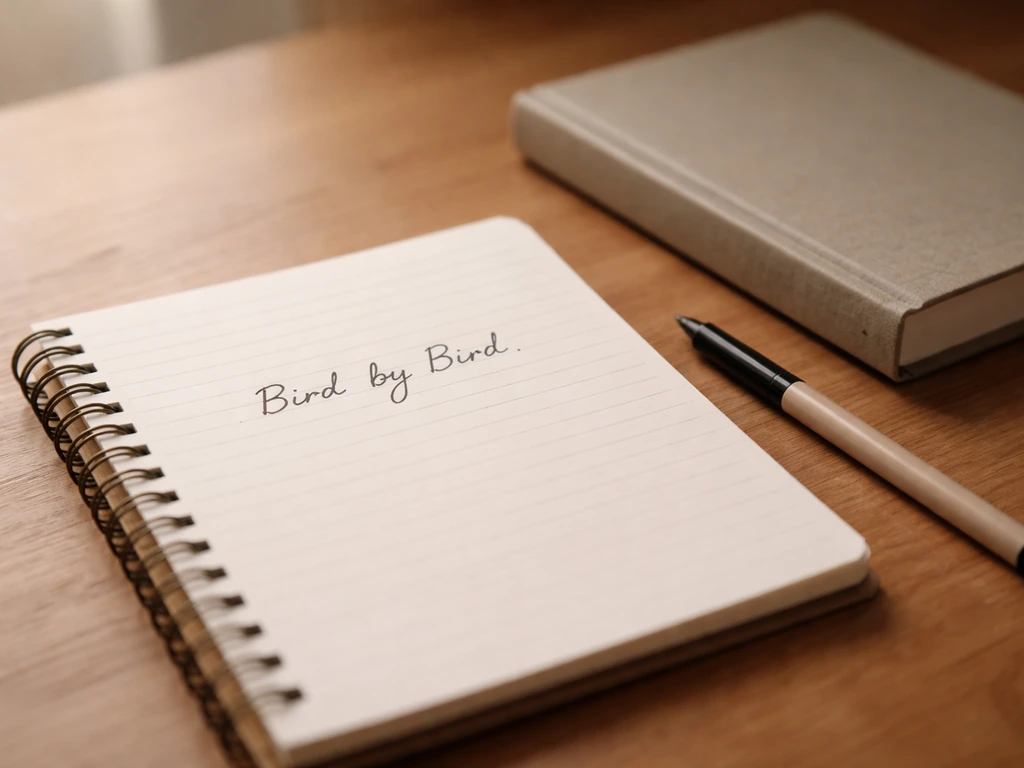
The phrase is most closely associated with Anne Lamott's 1994 book "Bird by Bird: Some Instructions on Writing and Life. This PDF excerpt hosted on an Illinois public university site includes notes tied to Bird by Bird, which can help frame discussion of its writing guidance blank" rel="noopener noreferrer">Bird by Bird: Some Instructions on Writing and Life. " Lamott explains the title in the book's introduction with a childhood story about her brother. He was ten years old and completely overwhelmed by a school report on birds that he'd put off for three months. He sat at the kitchen table, near tears, surrounded by books, binder paper, and pencils, paralyzed by how much he had to do. Their father sat down next to him, put his arm around him, and said: "Bird by bird, buddy. Just take it bird by bird."
Lamott chose that phrase as the title of her book and used it as the guiding principle throughout, applying it not just to writing but to creative work and life in general. The book became one of the most beloved writing guides ever published, which is why the phrase has such deep roots in writing and creativity circles today. If you've spent any time in workshops, writing groups, or creative coaching spaces, you've almost certainly heard it.
Interestingly, the phrase also found its way into popular culture through television. The "bird by bird" reference in Ted Lasso introduced the concept to an entirely new audience, framing it as therapeutic advice about not letting the scope of a challenge overwhelm you before you even begin.
Literal vs. figurative meaning (and what people get wrong)
Literally, "bird by bird" describes counting or handling birds one at a time, which is exactly what Lamott's brother needed to do for his school report. Figuratively, the birds are whatever units your large task can be broken into: paragraphs, pages, chapters, study topics, tasks on a to-do list, or steps in a project. The birds are always the smallest meaningful piece you can actually act on right now.
What people get wrong is confusing this phrase with other "bird meaning" searches. Someone looking up what birds mean in the Bible is asking a completely different question, one about symbolism, prophecy, and spiritual significance in scripture. "Bird by bird" is not an esoteric or symbolic phrase in that tradition. It's a practical idiom about incremental effort, and its meaning is entirely secular and modern. People also sometimes misread it as a phrase about patience or patience with others, but it's more specifically about managing your relationship with a task, not with a person.
Another common mix-up: some readers stumble across the phrase while looking up general alternative bird meanings in idioms and slang, expecting something edgier or more metaphorical. "Bird by bird" isn't slang. It's not coded language. Its meaning is exactly what it sounds like once you know the story: one at a time.
How to use it correctly in conversation and writing

You use "bird by bird" when someone (or you yourself) is expressing overwhelm about a large task. It works as encouragement, as a reminder, or as a framing device for how you're going to approach something. You can say it directly as advice or use it as a personal mantra. It fits naturally in both spoken conversation and written communication, especially in creative, educational, or professional development contexts.
A few things to keep in mind when using it. First, it lands best when the listener already knows the reference or when you briefly explain it, otherwise it can sound oddly cryptic. Second, it works better for tasks that are large and complex than for tasks that are simply difficult in one moment. And third, it's a phrase that invites slowing down, so use it when the problem is scope and paralysis, not when someone genuinely needs to move fast.
When "bird by bird" fits: real examples
The phrase applies cleanly across a surprisingly wide range of situations. Here are some real scenarios where it works:
- Writing a thesis or long paper: Instead of staring at a blank document and thinking about 80 pages, you write one paragraph. Then the next. Bird by bird.
- Starting a creative project: A novel, a screenplay, a podcast series. The scope is overwhelming. Lamott's advice is to do the smallest workable unit of writing first, one scene, one draft pass, one page.
- Studying for exams: Rather than trying to review an entire semester in one session, you cover one topic or one chapter at a time until the material is done.
- Work projects with big deliverables: A product launch, a strategic plan, a major presentation. You break it into the smallest tasks you can actually complete today and move through them one at a time.
- Managing creative anxiety or perfectionism: When fear of the finished product is keeping you from starting, "bird by bird" is the instruction to stop thinking about the finished product entirely and just do the next small thing.
In all of these cases, the phrase does the same thing: it reframes the challenge from "how do I finish this enormous thing" to "what is the one next thing I can do right now." That's a meaningful cognitive shift, and it's why the phrase has stayed relevant for decades.
How to apply the mindset today: a simple action plan
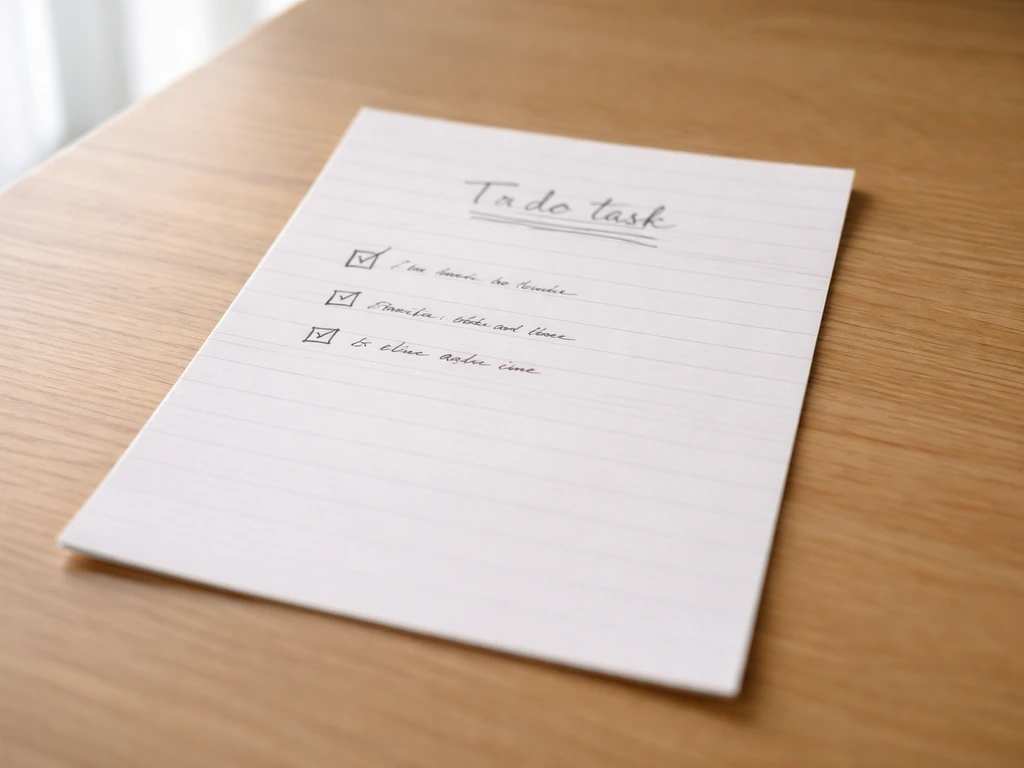
If you've been searching for what "bird by bird" means, there's a decent chance you're facing something that feels too big right now. Here's a quick way to apply the idea immediately.
- Write down the full task or project in one sentence. Don't break it apart yet, just name the whole thing.
- Identify the three to five major components it contains. These are your big categories of birds.
- Pick the smallest, most concrete action inside the first component. Not "work on chapter one," but "write the opening paragraph of chapter one." That's your first bird.
- Do only that one thing. Give it a time block of 20 to 30 minutes if it helps to have a container.
- When it's done, identify the next smallest action. That's your second bird. Repeat.
- At the end of the session, note what you finished. This is important: the point of the method is also to feel the momentum of actually completing things, even small things.
Lamott also talks about getting quiet and listening to your "still small voice" when you don't know what to do next. In practice, that means pausing when you're overwhelmed and asking yourself: what is the one next real step I can actually take? Not the whole plan. Just the next bird. That question cuts through a lot of paralysis very quickly.
Related bird expressions worth knowing
"Bird by bird" belongs to a broader family of expressions built around the idea of breaking things into smaller pieces. Understanding how it fits alongside these phrases helps you use it more precisely and avoid mix-ups.
| Expression | Core Meaning | Best Use Context |
|---|---|---|
| Bird by bird | Do a large task one small piece at a time | Writing, creative work, projects, studying |
| One step at a time | Progress incrementally without rushing | General goal-setting, emotional overwhelm |
| Baby steps | Start extremely small, especially when afraid | New skills, anxious beginners, therapy contexts |
| One at a time | Handle things sequentially, not simultaneously | Multitasking problems, prioritization |
| Eat the elephant one bite at a time | A big task only gets done through small sustained effort | Business, project management |
The key distinction between "bird by bird" and the others is its literary and creative lineage. When you use "bird by bird," you're invoking Lamott's tradition, which carries a specific warmth and artistic credibility that a phrase like "eat the elephant" doesn't have. It's the right phrase for writing, creative work, and any situation where someone is paralyzed by the scale of something they care deeply about.
People sometimes ask whether "bird by bird" has any connection to how a bird person might approach things, meaning someone who thinks in the patient, observational way a birdwatcher does. It's an interesting parallel: birdwatching itself is fundamentally a practice of focused attention on one thing at a time. But the phrase itself isn't drawn from that tradition. It comes from a specific story about a specific school report, and that origin is what gives it its meaning.
There's also no meaningful overlap between "bird by bird" and more niche expressions like ball bird meaning, which belongs to a completely different category of bird-related slang. If you ran across that phrase and ended up here, the meanings don't share any common ground. "Bird by bird" is its own idiom with its own clear origin and purpose.
If you want to go deeper on the phrase itself and explore how it's been unpacked in different writing and coaching contexts, what "bird by bird" means as a concept has been discussed extensively in creative writing communities for good reason. It's one of the few pieces of writing advice that doubles as genuine life advice, and that's exactly why it has lasted.
FAQ
When someone says “bird by bird,” does it mean I should work slowly, or just make incremental progress?
It typically means “do the smallest action that moves the project forward,” not “make zero progress until you feel motivated.” A quick check is whether the next step produces something concrete (a paragraph draft, a single quiz question, a calendar block) you can build on later.
What if I’m overwhelmed but I can’t start because I’m waiting on someone else or something outside my control?
If the task has a fixed external dependency (for example, waiting for approval, equipment, or data), the “next bird” is still the next controllable move, like drafting a request email, listing assumptions, or prepping the materials needed for when the dependency clears.
Is “bird by bird” helpful when there’s a deadline, or is it only for long-term projects?
Use it when overwhelm comes from scope and paralysis. Don’t use it as a substitute for urgency: if there is a hard deadline, you should still create a short plan and time-box the work, then apply “bird by bird” within those time blocks.
What if I understand the idea already, but I still don’t know what my “next step” is?
If you already have a clear next action, the phrase may be less useful. In that case, apply the idea internally as a sanity check: ask whether you’re trying to do too big a unit (like an entire report) instead of a smaller unit (like an outline section or a first draft of one paragraph).
How do I decide what counts as a “bird,” when everything seems equally big and abstract?
The smallest meaningful unit should be “testable,” not “vague.” For example, “research” is too broad, “collect three sources and summarize each in two sentences” is actionable. If you can’t describe the outcome in one sentence, it’s probably not small enough yet.
Can I use “bird by bird” to encourage someone who’s stressed, or only when they’re overwhelmed by a task?
The phrase is about managing your relationship with the task, so it usually isn’t the right response to a person who needs help for emotional reasons unrelated to workload (like anxiety that requires support). If the issue is work-related overwhelm, you can pair the encouragement with a specific offer, like “I can help you break down the first section.”
Is it okay to tell someone “bird by bird,” or does it risk sounding confusing?
Yes, but be careful with tone. It can sound cryptic if the listener has never heard the reference, so consider adding a concrete translation immediately, such as “let’s pick the next small action you can do in 15 minutes.”
How do I keep “bird by bird” from becoming procrastination in disguise?
Avoid turning it into an excuse for avoiding hard parts. A practical rule is to identify one “starter bird” that begins the task, then schedule the next birds so the work steadily moves toward the finish, even if some steps are uncomfortable.
What’s a good way to apply “bird by bird” when my energy levels vary day to day?
Pairing it with an “energy plan” helps. For low-energy days, choose birds that are short and low-friction (editing a paragraph, creating a checklist). For high-energy days, take the harder birds first. This keeps momentum even when your capacity changes.
How do I measure progress when I’m working in small steps and it feels like nothing is changing?
A quick self-audit is: “What did I do today that I can point to as a completed piece?” If the answer is “nothing,” the smallest next bird may be too big, or the step may not be defined well enough to finish. Reducing scope usually fixes it.
Next Article
Amber Bird Meaning: Symbolism, Interpretations, and How to Use It
Learn amber bird meaning: disambiguate the phrase and interpret it using amber and bird symbolism, grounded steps includ