
The phrase 'bird on a wire rat in a pocket' is not a single, stable, well-documented proverb. It's almost certainly a combined or paraphrased expression that blends two separate image clusters: the 'bird on a wire' frame (most famously anchored to Leonard Cohen's song, with its themes of exposure, constraint, and longing for freedom) and 'rat in a pocket' (which carries its own range of meanings: a hidden nuisance, a concealed threat, a literal small animal, or even a derogatory label for someone carried along as a controlled irritant). When you hear the full combined phrase, the most likely figurative meaning is a contrast between the visible and the hidden: something out in the open and vulnerable versus something concealed and potentially dangerous. Think exposed innocence versus hidden treachery.
Bird on a Wire Rat in a Pocket Meaning Explained


Where the phrase comes from
The 'bird on a wire' half of this expression has a clear cultural anchor. Leonard Cohen wrote 'Bird on the Wire' (sometimes titled 'Bird on a Wire') in the late 1960s, and the song became one of the most quoted and covered pieces in the modern folk-rock canon. Cohen himself described the song as a kind of personal apology, a statement about being caught between freedom and obligation.
The image of a bird perched on a wire, neither fully free nor fully caged, became shorthand for that liminal state: exposed, constrained, watched. That imagery has since been borrowed, paraphrased, and recycled across film, TV, commentary, and everyday speech, which is why 'bird on a wire' carries such reliable symbolic weight even when people can't name its origin.
The 'rat in a pocket' half is murkier. There is no single canonical source that pairs it with 'bird on a wire' in a documented, widely-cited proverb. Phrase-origin communities and idiom databases do not record the exact combined string as a fixed saying with a traceable earliest use. What you're most likely dealing with is a hybrid: someone merged these two image clusters in a lyric, a riddle, a piece of slang, or conversational wordplay, and it spread informally from there. Modern rap lyrics, for example, sometimes bring 'wire' and 'rat' into the same metaphorical space, and the combination can feel like an established phrase even when it isn't.
What each image actually means on its own
The bird
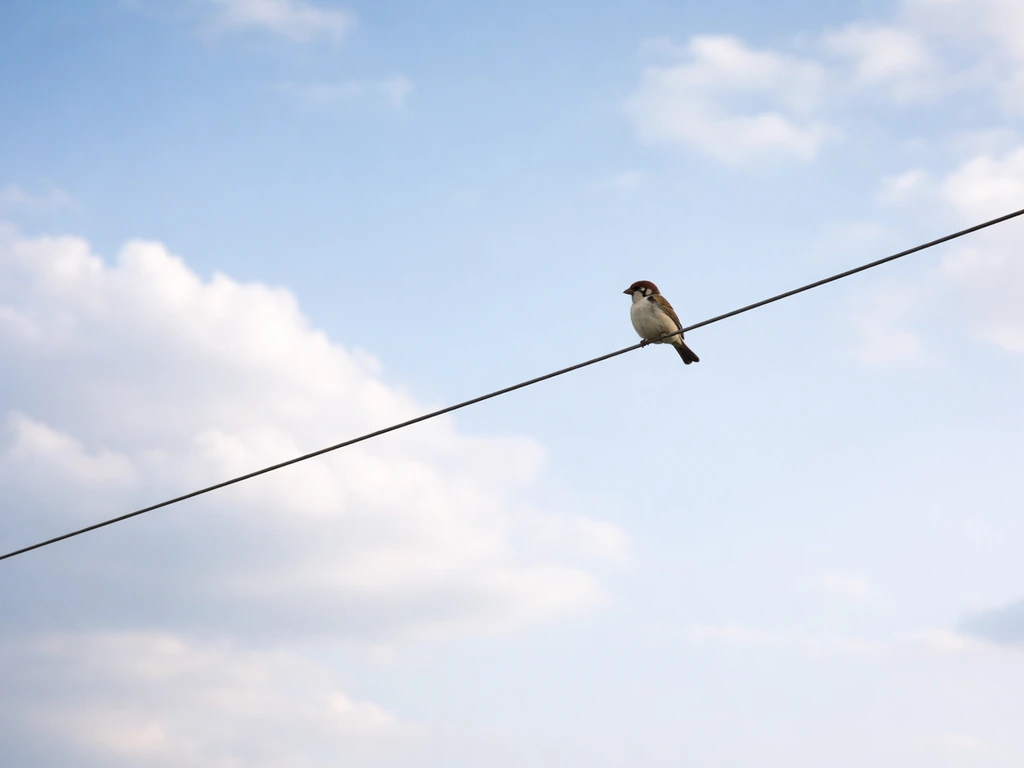
In idiom and folklore, birds almost universally represent freedom, the soul, aspiration, or some form of spiritual mobility. A bird that is not flying, though, carries the opposite charge: it signals a pause, a constraint, or a moment of vulnerability. Sitting still on a wire, the bird is visible to everyone. It's exposed. It hasn't escaped; it's just temporarily resting in a precarious in-between space. That's the literal image doing double duty as a figurative one.
The wire
The wire is the constraint. It's not a cage (full enclosure), and it's not open sky (full freedom). It's something thin, man-made, and utilitarian that an otherwise free creature has chosen, or been forced, to land on. In Cohen's framing, the wire represents human obligation, compromise, the structures of ordinary life that tether a person who might otherwise soar. In a slang or warning context, 'on the wire' can also imply being on edge, exposed to risk, or under surveillance.
The rat

Rat symbolism is almost universally negative in English idiom. A rat is a betrayer, an informer, someone who operates in the dark. The 'jailbird' and 'prison bird' idioms that relate to crime culture share territory with 'rat' in the sense that both can describe someone caught up in a system of confinement and consequence. The jailbird idiom is a related crime-culture term for someone who has been incarcerated. Importantly, though, 'pocket rat' also has a genuine zoological meaning: Merriam-Webster and Collins both list 'pocket rat' as a term for various rodents including kangaroo rats and pocket mice. That dual meaning (literal small animal vs. figurative concealed threat) is exactly why the phrase can be misread.
The pocket
A pocket is a concealed space. Hiding something in your pocket keeps it close, controlled, and out of sight. When the 'something' is a rat, the figurative reading almost writes itself: a hidden betrayer, a concealed danger, something dangerous that you're carrying without others knowing. But in pet communities, 'rat in a pocket' can be completely literal and even affectionate.
People who keep fancy rats often carry them in shirt pockets or jacket pouches, and the phrase 'pocket rat' in those spaces carries a warm, playful meaning rather than a sinister one.
AFRMA notes that pet rats and mice are sometimes carried in small pockets or pouches for convenient, practical transport and handling, supporting the idea that “rat in a pocket” can be literal in real captivity care practices rather than just folklore People who keep fancy rats often carry them in shirt pockets or jacket pouches.
What the combined phrase most likely means
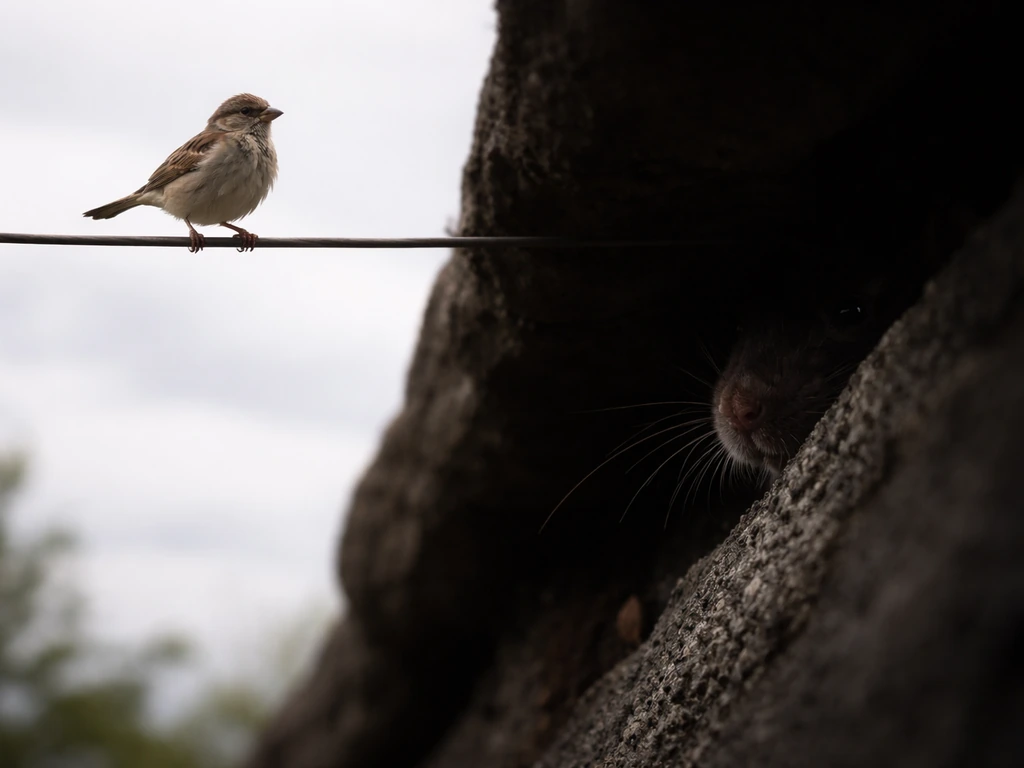
Put the images together and the dominant figurative reading is a contrast between visible vulnerability and hidden threat. The bird on a wire is in the open: exposed, watched, potentially in danger. The rat in a pocket is concealed: kept close, controlled, not yet revealed. When someone uses this combined phrase in a slang or lyric context, they're usually pointing at a situation where what's visible is not what's dangerous. The real threat is the thing nobody is looking at. In practical terms, people use it to mean: 'Don't watch the obvious thing; watch what's being carried quietly.' It's a warning about misdirection, concealment, and betrayal waiting in plain sight of the person carrying it.
A secondary reading is predator/prey dynamics: the rat (predator, opportunist) is being kept hidden near the bird (exposed, vulnerable). In that frame, the phrase signals that someone who looks unprotected is actually closer to danger than they realize, because the threat is already in position, just not visible yet. This maps onto older folk warnings about trusting the wrong companions.
Variations, similar sayings, and how to tell them apart
Because this isn't a fixed proverb, you'll run into variants and adjacent phrases that can muddy the interpretation. Here are the most common ones and how to distinguish them.
| Phrase / Variant | Most Likely Meaning | Key Indicator |
|---|---|---|
| Bird on a wire (alone) | Cohen-style: constraint, longing, liminal freedom | Cohen reference, song quote, personal reflection language |
| Rat in a pocket (alone, affectionate) | Literal: a pet rat being carried; cute/playful | Emoji, pet community, 'so cute,' 'pocket puppy' language |
| Pocket rat (as insult) | Derogatory: small annoying person, contained nuisance | Hostile dialogue, 'shut that ___ up,' contempt framing |
| Bird on a wire rat in a pocket (combined) | Figurative contrast: exposed vs. concealed threat/betrayal | Warning language, riddle format, slang, lyric context |
| Rat on a wire / bird in a pocket | Likely misquote or remix; reverse the logic to find the intended contrast | Confusion, paraphrase, loose attribution |
The most common disambiguation error is applying the pet-rat framing to what is actually a warning-slang context, or vice versa. The surrounding language is your best clue. If there are words like 'watch,' 'careful,' 'trust,' 'snitch,' or 'trap' nearby, lean toward the figurative betrayal reading. If there are affectionate animal terms, photos of rodents, or community-specific pet content, it's probably literal and playful.
Cultural and literary roots: freedom vs. hidden control
The tension between the exposed bird and the concealed rat taps into one of the oldest symbolic pairings in Western folklore: visible innocence versus hidden predation. Birds have long represented the soul's desire for freedom and transcendence, whether in Cohen's songwriting, in the biblical use of birds as signs of spiritual state, or in the broader folklore tradition where a caged or trapped bird signals a soul in bondage. The rat, meanwhile, occupies the shadow side: it operates in hidden spaces, it survives by concealment, and in English slang it has functioned as a betrayer figure for centuries.
Cohen's 'Bird on a Wire' specifically adds the dimension of willing constraint: the bird chooses to land on the wire, not because it's caged but because freedom itself is complicated. That nuance matters when you bring a rat into the same image. The bird may have chosen its exposed position out of exhaustion or compromise; the rat in the pocket was placed there deliberately by someone else.
That asymmetry of agency, the bird choosing exposure, the rat being controlled and concealed, gives the combined phrase its moral edge. It's not just a description of two animals. It's a comment on who is being watched, who is doing the watching, and who is being held in reserve. Some readers also connect the idea of being “like the bird” to Victor Hugo’s writing about freedom and moral imagery be like the bird victor hugo meaning.
This symbolic territory overlaps with other bird-related idioms in the same cultural space. Expressions about birds in cages with open doors, jailbirds, and prison birds all deal with the relationship between freedom, captivity, and the structures (wires, bars, pockets) that define those states. A similar idea appears in the bird in a cage with the door open meaning, where the “door” signals opportunity but not necessarily escape bird in a cage with open door meaning. The 'bird on a wire rat in a pocket' phrase sits in the same family, extending the metaphor into the territory of hidden threat rather than overt confinement.
How to apply the meaning when you encounter it
If someone uses this phrase in conversation or you encounter it in lyrics, here is what to look for in the surrounding context to confirm which reading applies.
- Check the tone first. Is the overall message a warning, a critique, or a boast? That pulls strongly toward the figurative betrayal/hidden-threat reading.
- Look at what the 'bird' represents in context. If it maps onto a specific person or situation described as vulnerable, exposed, or watched, you are in figurative territory.
- Look at what the 'rat in a pocket' represents. If it maps onto a person being carried, hidden, or kept close by someone in power, the concealment-and-control reading is almost certainly right.
- Check whether Cohen's song is being quoted or referenced. If yes, the 'bird on a wire' portion carries his meaning: constraint, longing, compromise. The rat extension then adds a layer of hidden danger to that already-constrained figure.
- If the phrase appears in rap or street slang without Cohen attribution, it likely carries the slang reading: someone visible and vulnerable is near someone concealed and dangerous.
- Avoid concluding that the phrase means the bird and the rat are the same entity. They are almost always contrasted, not equated.
- Do not assume the phrase is a stable proverb with one fixed meaning. Treat it as a constructed image and read the parts individually before combining them.
Still not sure? Work through this checklist
If the meaning still feels ambiguous after reading the sections above, run through these questions quickly. They cover the most common sources of confusion.
- Where did you see or hear the phrase? (Song lyric, conversation, social media post, riddle, movie dialogue?) Each source has a default interpretive register.
- Is Leonard Cohen's name or his song title mentioned anywhere nearby? If yes, start with his framework: constraint, yearning, exposed vulnerability.
- Is the surrounding language affectionate or hostile? Affectionate plus animal imagery means literal/playful. Hostile or cautionary means figurative threat.
- Is 'rat' being used as a noun for a person, not an animal? If someone is being called a rat, you're in betrayal/informer territory.
- Is 'pocket' being used as a verb or a noun for concealment? 'Keeping something in your pocket' idiomatically means hiding or controlling it.
- Can you find the original source? Search the exact lyric line or quote in a lyrics database or quote archive. If it appears only in fragments, you may be dealing with a paraphrase rather than a canonical saying.
- Does the phrase appear in a riddle format? If there's a question-and-answer structure, it may be a lateral-thinking puzzle rather than a traditional idiom, and the 'answer' is specific to that puzzle's logic.
- Check phrase-origin communities (like Phrases.org.uk or Straight Dope forums) for threads discussing 'bird on a wire' origins. These can clarify whether a variant with 'rat' has a documented history or is a modern informal construction.
- If you still can't pin it down, apply the most statistically common reading: visible vulnerability contrasted with concealed threat, drawn from the Cohen bird-on-wire frame combined with the English slang meaning of 'rat.'
FAQ
How can I tell whether “rat in a pocket” is meant literally or figuratively?
Yes. If the speaker is talking about pets, carrying, or animal behavior, “rat in a pocket” is usually literal (a small rodent carried in a pouch or shirt pocket). If the setting is a warning, conflict, or betrayal theme, “pocket” is more likely figurative (something concealed that can cause harm).
What words around the phrase are the best hints for the intended meaning?
Look for cue words. Terms like watch, careful, trust, snitch, trap, or betrayal usually push the interpretation toward “hidden threat” and misdirection. Words tied to care, rescue, breeding, cages, or pets push it toward the literal pocket-rat framing.
What’s a common mistake people make when interpreting this phrase?
In informal use, people often apply only the “bird on a wire” part, then assume the rat automatically means betrayal. That can be wrong. If the rat is mentioned without moral or warning language, treat it as context-dependent and do not force the “concealed traitor” reading.
Can the “bird on a wire” part mean anxiety or surveillance rather than betrayal?
If the line sounds like it’s describing feeling exposed, “bird on a wire” can mean being on edge or under scrutiny, even without crime imagery. The rat then either becomes a metaphor for anxiety or a literal carried nuisance, depending on whether the rest of the text stays emotional or shifts to threat.
How do zoological uses of “pocket rat” affect the interpretation?
Because “pocket rat” can refer to real rodents (like kangaroo rats or pocket mice) and also to a hidden “nuisance,” you should check whether the text mentions species, habitat, weather, or actual animal handling. Those details break the tie toward the zoological meaning.
If the phrase appears in lyrics, how can I avoid reading the wrong tone into it?
The tone matters. Lyrics or riddles often compress symbolism, but they usually maintain a consistent emotional direction. If the surrounding lines are tender or playful, don’t assume a sinister hidden-danger reading. If the surrounding lines are adversarial or cautionary, assume the hidden-threat reading until proven otherwise.
Can the phrase be used as practical advice, like “don’t be distracted”?
Yes, sometimes it functions as a direction to pay attention to what is unseen, not what is obvious. In that usage, the “bird” is the distractor and the “rat” is the overlooked risk, so the meaning can be close to, “Don’t focus on the surface.”
Does the phrase apply to social betrayal, like gossip or backstabbing?
If the context is about relationships or social groups, the “rat in the pocket” reading can resemble gossip, backchanneling, or someone playing both sides while staying close. However, keep it literal-minded if the speaker is talking about secrecy in general, not active wrongdoing.
What should I do if I still can’t tell the meaning after checking the context?
If you’re trying to interpret it in conversation, ask a clarifying question rather than locking onto a single meaning. For example: “Do you mean something hidden and dangerous, or are you using it as an animal/pet image?” This works especially when the speaker is quoting or adapting a line they heard elsewhere.
Speak Now Bird Cage Meaning: Literal and Symbolic Insights
Explains speak now bird cage meaning: urgency to speak, silence and confinement themes, plus context and how to respond.
