The phrase "that could abash the little Bird" comes directly from Emily Dickinson's poem "'Hope' is the Thing with Feathers" (1861), and it means: only a truly devastating storm could embarrass, silence, or overwhelm the small, resilient bird that represents hope. In plain modern English, Dickinson is saying that hope is so persistent and tough that almost nothing can shake it.
That Could Abash the Little Bird Meaning and Usage

Marcus Winters
22 May 2026
The "little Bird" is not a real species, it is hope itself, personified as a small creature that keeps singing no matter what. If you are also curious about “little bird meaning” in other contexts, that symbolism often points to hope, messages, or the soul this little bird meaning.
If you are asking about the name “Evelyn” and its meaning as “little bird,” that is a related way people connect birds with tenderness and resilience, similar to how Dickinson’s “little Bird” stands for hope evelyn meaning little bird. If you are looking into the name "Jenna," you may also see it connected to the idea of a little bird Jenna name meaning little bird.
What "abash" actually means (and why it trips people up)

"Abash" is a verb meaning to embarrass someone, make them feel ashamed, or cause them to lose their composure. Cambridge defines it simply as "to embarrass someone or make them feel uncomfortable," and blank" rel="noopener noreferrer">Merriam-Webster puts it as "to put to shame." The related adjective "abashed" describes the person on the receiving end: blank" rel="noopener noreferrer">awkward, embarrassed, thrown off balance. So "nothing could abash her" means nothing could embarrass or faze her.
The word has deep roots. It traces back through Middle English forms like "abaissen" and "abaschen," which carried meanings like "to lose one's composure" or "to be amazed and thrown off." French and Romance-language origins pushed those meanings toward the idea of being put down or startled into silence. By the 16th century, English had settled into the modern sense: to cause someone (or something) to feel shame, embarrassment, or discomfiture.
The reason "abash" trips readers up today is that it almost never appears in everyday conversation. Most people would say "embarrass," "rattle," "shake," or "silence" instead. So when you see it in Dickinson's line, it can feel archaic or even slightly threatening in tone. That atmosphere is intentional, Dickinson is describing a storm powerful enough to do something that almost nothing can: unsettle hope itself.
The "little Bird" as metaphor, not a real bird
In the poem, Dickinson never specifies a species. The bird is entirely metaphorical: it stands for hope, which she imagines perching in the human soul and singing continuously, even in the dark. In this same line, people often ask what “Henry Lee” is supposed to mean, but the “little bird” is really pointing back to the poem’s idea of hope. The smallness of the bird is deliberate, it signals vulnerability, fragility, something easy to overlook.
In everyday discussion, you will also see people ask what the “pretty little bird meaning” is in relation to hope and resilience. And yet this tiny creature keeps singing through storms, through "the chillest land" and "the strangest Sea. " The contrast between its size and its persistence is the whole emotional point.
This use of "little bird" as a symbol of something tender yet enduring fits a long tradition in language and folklore. This use of "little bird" as a symbol of something tender yet enduring also connects nicely to the idea behind "jenna name meaning little bird". Birds in general carry connotations of freedom, the soul, and messages from beyond the ordinary world. A little bird specifically tends to represent something delicate but spiritually significant, which is why Dickinson's choice lands so well. She is not describing a hawk or an eagle.
She is describing something small enough to be dismissed, something that could theoretically be silenced. In some cultures, a small bird is also linked to meanings about hope, messages, and endurance, which fits the poem's idea of a persistent heart a hawk or an eagle. That makes the storm's failure to silence it all the more powerful.
If you have come across related expressions like "a little bird told me" or explored the symbolism behind phrases involving small birds in song or folklore, you will recognize this same pattern: the little bird carries weight far beyond its size, acting as a vessel for messages, feelings, or forces that are invisible but real. The phrase “a little bird told me” is a different saying, but it similarly suggests that a message can come from somewhere unseen a little bird told me meaning.
Where the phrase comes from: Dickinson's poem in context
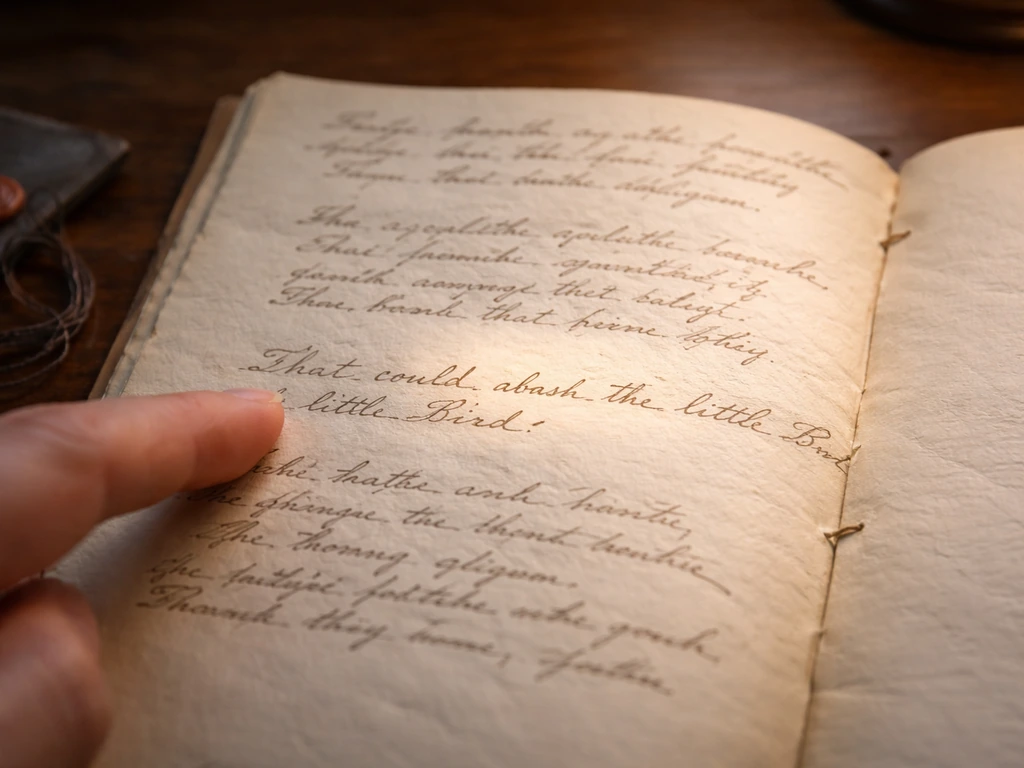
Dickinson wrote "'Hope' is the Thing with Feathers" around 1861, collecting it in one of her hand-sewn fascicles (small booklets she assembled herself). It was not published until 1891, appearing in "Poems by Emily Dickinson, Second Series." The poem uses an extended metaphor throughout: hope is a bird, the bird lives inside the soul, it sings constantly, and it asks for nothing in return. The full lines that contain your phrase read:
- "And sore must be the storm —"
- "That could abash the little Bird"
- "That kept so many warm —"
Read together, these lines form a conditional statement: the storm would have to be extremely severe ("sore") to abash (embarrass, silence, overwhelm) the little bird that has kept so many people's hope alive. It is not saying the storm cannot come. It is saying the storm would need to be something extraordinary to succeed. That is a quietly defiant claim about hope's resilience.
Translating the phrase into plain modern English
Because the phrasing is poetic and "abash" is uncommon, a few different modern translations work depending on the shade of meaning you want to preserve. Here are the most accurate options:
| Original phrase | Modern paraphrase | Emphasis |
|---|---|---|
| That could abash the little Bird | That could silence the little bird | Quieting / suppressing hope's song |
| That could abash the little Bird | That could overwhelm the little bird | Sheer force overpowering something fragile |
| That could abash the little Bird | That could shame or rattle the little bird | Closest to the literal dictionary meaning of 'abash' |
| That could abash the little Bird | That could knock the spirit out of the little bird | Emotional disruption / loss of composure |
In Dickinson's specific context, "overwhelm" or "silence" carries the meaning most faithfully. The storm is not just making hope feel awkward, it is trying to shut it down entirely. Using "embarrass" alone in a modern paraphrase technically fits the dictionary, but it undersells the power of what Dickinson is describing.
Tone, context, and how to use it today
This phrase is not an idiom you would drop casually into a text message. Its register is literary and slightly formal, carrying the weight of its poetic origin. That said, it works beautifully in a few modern contexts:
- Eulogies or tributes, when you want to describe someone whose spirit could not be broken
- Essays or speeches about resilience, mental health, or perseverance
- Literary analysis or discussion of Dickinson's poetry
- Captions or quotes accompanying artwork, photography, or journaling about hope
- Sermons, devotionals, or reflective writing where the bird/hope metaphor adds emotional depth
The tone is reflective and admiring, not aggressive. When someone quotes this line, they are usually making a point about how tough hope is, or how tough a particular person's spirit has been, in the face of serious adversity. It is a compliment wrapped in vintage language.
Example sentences and common misunderstandings
Example sentences using the phrase or its meaning
- "She went through loss, illness, and years of uncertainty — and yet, as Dickinson put it, no storm could abash the little bird in her."
- "The poem reminds us that hope is persistent: 'sore must be the storm that could abash the little Bird.'"
- "His resilience was something else. Nothing that happened in those years was enough to abash the little bird — his faith just kept singing."
- "When I read 'that could abash the little Bird,' I finally understood what Dickinson meant: hope does not go quiet easily."
Mistakes to avoid
- Do not confuse "abash" with "bash" (to hit). The words look similar but mean different things entirely. Abash is about emotional disruption, not physical force.
- Do not assume the little bird refers to a specific bird species. Dickinson uses no species name — the bird is purely symbolic.
- Do not read the phrase as saying hope can be defeated. The conditional construction ("sore must be the storm THAT could abash...") implies the bar is so high that almost nothing clears it.
- Do not use "abash" in casual speech expecting to be understood without explanation. Most people will not recognize it outside literary or formal contexts.
- Do not mistake the phrase for a standalone proverb or common idiom. It is Dickinson's specific wording from a specific poem — always attribute it correctly.
Quick checklist for interpreting the phrase
- Identify the source: this line comes from Dickinson's "'Hope' is the Thing with Feathers" (c. 1861). That context shapes everything.
- Translate "abash" as "overwhelm," "silence," or "put to shame" depending on how much force the surrounding text implies.
- Remember "the little Bird" = hope (not a real bird, not a specific species).
- Read the full conditional: the storm would need to be extreme ("sore") to even have a chance of abashing the bird. The phrasing implies it usually fails.
- Match your paraphrase to the context: use "silence" for emotional suppression, "overwhelm" for sheer force, "embarrass or shame" only if you are sticking close to the dictionary definition.
- If you are quoting the line yourself, keep it in its poetic register — pair it with similarly thoughtful, reflective language rather than casual speech.
- When someone uses this phrase around you, the intended meaning is almost always admiration for resilience: something small and vulnerable kept going despite enormous pressure.
FAQ
Does “that could abash the little bird” mean hope can never be harmed?
Not exactly. It means hope is so resilient that only an unusually powerful storm could stop it, not that no trouble can ever arrive. Dickinson’s conditional phrasing leaves room for hardship, but emphasizes how hard it is to silence hope completely.
Is “abash” here about embarrassing the bird, or is it about silence and being shut down?
In this line, the strongest sense is discomfiture that stops the bird’s singing. “Embarrass” can fit the dictionary meaning, but Dickinson’s broader image (a bird that keeps singing through storms) points more toward silencing or overpowering than mere awkwardness.
What does the phrase sound like in modern English, if I want to paraphrase it?
A close paraphrase is “nothing short of an extraordinary storm could overwhelm hope” or “only a devastating storm could silence hope.” If you want to keep the emotion, choose verbs like “overwhelm,” “shut down,” or “silence,” rather than only “embarrass.”
Is the “little bird” meant to be a specific species or just a symbol?
It is purely metaphorical. Dickinson does not tie it to a real species, the point is the bird’s smallness and vulnerability contrasted with its stubborn persistence.
Can I use this phrase in a text message or casual conversation?
Usually it reads too literary for everyday chat. It works best in reflective writing (essays, captions, letters) where the formal, vintage tone matches the seriousness of the message.
What’s a common mistake people make when using this line?
A frequent error is treating it like a literal statement about a real bird or using “abash” to mean only “make someone feel awkward.” That misses Dickinson’s intent, where the real emphasis is stopping hope’s ongoing singing.
How should I handle it when I only quote part of the line?
If you quote only “abash the little bird,” readers may not infer hope unless surrounding context is clear. It’s safer to include at least a hint of what “the little bird” stands for, such as mentioning hope or resilience in the same sentence.
Is “Hope” always capitalized in this context, and does that matter?
In the poem, hope is treated like a central, almost personified force, so capitalization reinforces the symbol. If you paraphrase, you can either keep “Hope” for emphasis or use “hope” if you are making it more general, but be consistent with your tone.
If I want to make the tone less intense, is there an alternative to “storm”?
Yes, you can swap in a less catastrophic image depending on what you are describing, such as “hard times” or “rough days.” Just avoid changing the structure too much, because the line’s power comes from the idea that only something extreme could do the silencing.
How does this phrase relate to the other “little bird” expressions people mention, like “a little bird told me”?
They share the small-bird symbolism idea, but they are not the same message. “A little bird told me” usually signals hearsay or a message from an unseen source, while Dickinson’s “little bird” is hope itself, enduring through adversity.
Next Article
Evelyn Meaning Little Bird: Name Origin and Symbolism Guide
Evelyn meaning little bird: name etymology plus symbolism for why people link Evelyn to a “little bird” nickname.