There is no single universal 'lucky bird.' When someone says or searches 'lucky bird meaning,' they could be referring to a specific Yorkshire folklore tradition where the first person to enter your home on New Year's Day is literally called 'the Lucky Bird,' or they might mean one of several bird species (cranes, cardinals, swallows, storks, doves) that different cultures treat as symbols of good fortune. Because the looney bird meaning varies by folklore and region, the context you found it in matters most lucky bird meaning. The meaning shifts entirely depending on the tradition, region, and context you're working from. Here's how to sort it out.
Lucky Bird Meaning: Symbolism, Folklore, and Regional Uses

Marcus Winters
26 Jun 2026
What people usually mean by 'lucky bird'
In everyday English, 'lucky bird' gets used in a few genuinely different ways. The most casual use is as a nickname or compliment for a person or pet who seems to have good fortune on their side. If you've ever seen someone on a pet forum post 'he's one lucky bird' about a rescued budgie, that's the most common conversational usage: affectionate, informal, not tied to any specific symbolism.
The second use is more specific and rooted in British folklore, particularly Yorkshire. In the first-footing tradition, 'the Lucky Bird' (also called 'Bod' in Yorkshire dialect) is the very first person to cross the threshold of a home after midnight on New Year's Day, or sometimes on Christmas morning. This person isn't a bird at all. The name 'Lucky Bird' here is a ceremonial role with a specific checklist attached: the first-footer is expected to bring tokens like coal, bread, money, and salt to secure the household's fortune for the year ahead. Their appearance matters too, with some versions of the tradition treating dark-haired visitors as luckier than fair or red-headed ones.
A third use is purely commercial. 'Lucky Bird' shows up as a tattoo studio name, a casino brand, and various other business names. If your search landed you here after seeing 'Lucky Bird' on a sign or website, that's almost certainly a brand borrowing the lucky connotation rather than referencing any cultural tradition.
Common 'lucky bird' candidates and their symbolism
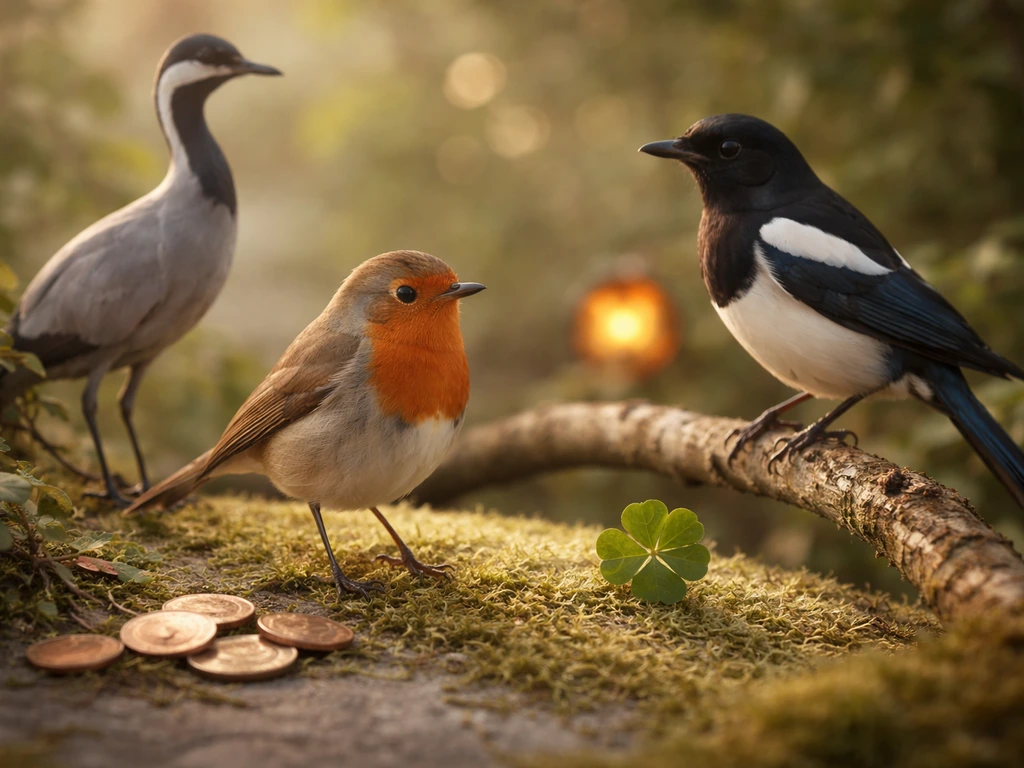
When people do mean a literal bird species, several candidates come up repeatedly across different traditions. None of them holds the title universally, but each has a strong claim in at least one culture.
| Bird | Primary Lucky Association | Tradition/Region |
|---|---|---|
| Crane | Good fortune, longevity, wish-granting | Japan (folding 1,000 origami cranes is believed to grant a wish) |
| Cardinal | Protection, good luck | Cherokee mythology and broader North American symbolism |
| Swallow | Safe return, family prosperity, spring renewal | Japan (tsubame), U.S. sailor and tattoo folklore |
| Stork | New life, blessing of a family | European folklore (delivery of babies as a positive omen) |
| Dove | Peace, love, protection, messages from lost loved ones | Greek/Roman mythology, early Christian symbolism, modern spirituality |
| Magpie | Good luck, fortune | East Asian cultures, especially China |
| Kingfisher | General good luck | English-language superstition tradition |
| Owl | Mixed: lucky in Japan, protective in some Chinese contexts, ominous elsewhere | Varies widely by region and era |
A few of these deserve a closer look because they come up most often in 'lucky bird' conversations. The Japanese crane is probably the most globally recognized 'lucky bird' symbol: fold 1,000 paper cranes (called senbazuru) and your wish is granted, according to tradition. Japanese tradition also links cranes to good fortune and longevity, including the wish-granting effect of folding a thousand paper cranes (senbazuru) blank" rel="noopener noreferrer">fold 1,000 paper cranes (senbazuru) and your wish is granted. Cranes represent both longevity and good fortune, which makes them a frequent choice for gifts, tattoos, and wedding décor across many cultures now, not just Japanese ones.
The cardinal gets its lucky reputation partly from Cherokee mythology, where it's associated with protection and good luck, and partly from its visibility in North American gardens. Because cardinals don't migrate and show up year-round, people see them as reliable presences, which reinforces their symbolic role as guardians or omens of good fortune. If you've heard someone say a cardinal visiting after a death means a loved one is watching over you, that's a related but slightly different symbolic thread connecting the cardinal to messages rather than just luck. That overlaps with the symbolism explored in discussions about what birds mean in terms of love and connection.
Swallows are interesting because their luck meaning is tied directly to their behavior. They return to the same nesting sites year after year, which made them powerful symbols of safe homecoming for sailors and travelers long before the phrase became a tattoo staple. In Japan, the swallow (tsubame) specifically represents family prosperity and the arrival of spring, and harming a swallow's nest is considered bad luck.
Doves sit at the intersection of luck, love, and spiritual protection. If you are asking specifically about a loving bird meaning, it often points to symbols like doves that are linked with love and affection. Their association with Aphrodite and Venus in Greek and Roman mythology planted them firmly in the 'love bird' category, but doves also carry a separate layer of spiritual meaning in many modern traditions, where seeing one near your home is read as either good luck or a message from someone who has passed. That dual symbolism makes them one of the most frequently cited 'lucky birds' in a spiritual or personal context.
Cultural and regional differences in luck meanings
This is where it gets genuinely complicated, and it's the reason a single 'lucky bird' definition doesn't hold up. The same bird can mean opposite things depending on where you are and what century you're drawing from. The owl is the clearest example: in Japan the owl is considered lucky and is a popular good-luck charm, but in traditional Chinese culture the owl has historically been associated with misfortune and bad omens, even though some regional Chinese traditions also credit owls with protective power at funerals. That's not a contradiction in the sources. It's just an accurate picture of how bird symbolism actually works across cultures.
The magpie follows a similar pattern. In East Asian cultures, particularly China, the magpie is a widely recognized symbol of joy and good fortune. In some Western European traditions, a lone magpie is a bad omen ('one for sorrow'), while two magpies bring joy. The counting rhyme most English speakers know treats the bird very differently from the Chinese tradition.
The stork's luck meaning is almost entirely tied to European birth folklore. The story of storks delivering babies has roots in older European beliefs about storks nesting on rooftops being a sign of blessing and protection for the family below. In other regions, the stork carries no particular lucky meaning at all.
The Yorkshire 'Lucky Bird' first-footing tradition is almost entirely a British Isles phenomenon. Outside that geographic and cultural context, calling the first visitor of the New Year a 'Lucky Bird' would mean nothing to most people. So if you encounter the phrase in a British or Northern English context, especially around the New Year, this is the most likely meaning.
How 'lucky bird' shows up in sayings, spirituality, and everyday talk
In everyday conversation, 'lucky bird' almost always functions as a compliment. Telling someone 'you lucky bird' means roughly what 'you lucky devil' or 'lucky you' means: an informal acknowledgment of someone's good fortune, with no specific bird symbolism attached. It's common in British and Australian English in particular.
In spiritual and new-age contexts, the phrase gets used more intentionally. Someone describing a bird sighting as a 'lucky bird encounter' is usually drawing on the broader tradition of birds as omens or messengers, often in the context of cardinals, doves, or robins appearing after the death of a loved one. In that loved-one context, people may connect the bird sighting to the robin bird meaning as a sign of remembrance and love death of a loved one. The idea is that the bird's appearance carries a message or blessing rather than just happening to be there. This overlaps with the symbolism around birds and love, as well as the broader idea of birds as spiritual messengers.
In folklore and traditional sayings, specific bird encounters get framed as lucky signs. Seeing a kingfisher is described in English superstition as very lucky. A swallow nesting in your eaves is a good omen. A crane spotted during a journey suggests safe travel. These aren't really about a single 'lucky bird' species but rather a general folk tradition of treating unexpected or special bird sightings as meaningful.
The Yorkshire first-footing use is unique because 'Lucky Bird' is a named ceremonial title, not just a metaphor. If you're reading about Northern English New Year customs and the term appears, it refers specifically to the first-footer role, complete with the token-bringing checklist and the rules about hair color and timing.
How to identify the intended bird meaning in your specific context

The fastest way to narrow down what 'lucky bird' means in any particular case is to ask a few quick questions about where you encountered the phrase. If you want to pin down what it means for you, start by looking at the specific bird symbolism or folklore being referenced what 'lucky bird' means.
- Is it connected to New Year's Day or a home visit? If yes, you're almost certainly looking at the Yorkshire first-footing tradition. Look for mentions of coal, bread, salt, or the visitor's hair color as confirmation.
- Is it a tattoo design or a studio name? If you're researching a tattoo, 'Lucky Bird' is likely either a studio name or a design referencing swallow or crane symbolism from sailor and Japanese traditions. Ask what specific bird the design uses.
- Is it in a spiritual or grief context? A 'lucky bird' appearing after someone's death or during a difficult period usually points to dove, cardinal, or robin symbolism, with the bird acting as a messenger or sign of comfort rather than literal luck.
- Is it in a children's book, film, or product name? These uses borrow the phrase for its positive connotation and may reference a specific species (often a bluebird, which carries its own 'bird of happiness' symbolism) or no species at all.
- Is it a compliment about a person or pet? If someone called you or your animal a 'lucky bird,' there's no hidden symbolism. It's the same as calling someone lucky, just with a more colorful delivery.
- Is it tied to a specific cultural tradition? If someone is discussing Chinese New Year, Cherokee heritage, Japanese origami, or European stork folklore, the 'lucky bird' they're referencing will be specific to that tradition. Match the culture to the bird using the table above.
If you're still genuinely uncertain after working through those questions, the safest approach is to go back to the source. Ask the person who used the phrase, check the broader context of the text or image it appeared in, or look at the cultural background of whoever is communicating it. Bird symbolism is almost always culturally embedded, so the cultural origin is your best clue.
Quick meaning recap and common misconceptions
Here's the fast version of everything above, plus a couple of things people get wrong.
- Yorkshire/British folklore: 'Lucky Bird' = the first person to enter a home on New Year's Day, a ceremonial first-footer role with specific tokens and appearance rules.
- Japanese tradition: the crane is the iconic lucky bird, representing good fortune and longevity, with the 1,000 origami cranes tradition attached.
- North American contexts: the cardinal is frequently cited as a lucky/protective bird, particularly in Cherokee tradition and modern spiritual belief.
- European folklore: the stork brings new life and blessing; the swallow brings safe return and family prosperity.
- Global spiritual use: doves represent luck, peace, love, and messages from deceased loved ones across multiple traditions.
- East Asian symbolism: the magpie is a strong luck symbol, distinct from its more mixed reputation in Western European traditions.
- Casual English: 'lucky bird' is also just an informal way to call someone fortunate, with no species or symbolism implied.
The biggest misconception is assuming there's one definitive 'lucky bird' that applies everywhere. There isn't. A second common mistake is treating folklore and superstition as interchangeable with cultural symbolism. These are related but different things. Cultural symbolism (like the Japanese crane or the Chinese magpie) reflects deep, longstanding traditions tied to a community's values and worldview. Superstition tends to be more personal and less systematized, like the idea that seeing any bird tap on your window carries a message. Both are worth understanding, but it's worth being honest about the difference when you're sharing or interpreting a meaning so you're not overclaiming what the symbol actually represents in its original context.
If you're drawn to bird symbolism more broadly, the connections run deeper than just luck. Birds show up in cultural and folkloric traditions as symbols of love, belief, mourning, and renewal. Understanding which tradition a specific bird belongs to is always the key to reading the meaning accurately, whether you're decoding a tattoo, understanding a phrase someone used, or exploring what a bird sighting means to you personally. Understanding which tradition a specific bird belongs to is always the key to reading the lovely bird meaning accurately, whether you're decoding a tattoo, understanding a phrase someone used, or exploring what a bird sighting means to you personally.
FAQ
How can I tell if “Lucky Bird” refers to Yorkshire first-footing versus a literal bird species?
If you are unsure whether the phrase means a specific bird species or the Yorkshire first-footing role, check for non-bird clues like New Year timing, “first-footer,” token items (coal, bread, money, salt), or dialect terms such as “Bod.” Those cues usually point to the ceremonial role, not an actual bird.
Does “lucky bird” mean something specific when someone says it to me in casual conversation?
Usually, no. In most modern everyday use, “you lucky bird” is just an affectionate compliment. It does not require a specific animal symbol, and insisting on one can lead to awkward overinterpretation.
What should I assume if I encounter “Lucky Bird” on a business name or tattoo studio?
Be careful if the source is a sign, tattoo portfolio, casino brand, or merch. Those uses often borrow the lucky association for marketing, so the meaning you want is typically “branding connotation,” not a traditional folklore code.
Why can the same bird have opposite lucky meanings in different places?
Look for the setting, not just the bird. The same species can be read differently across cultures and time periods (for example, owl symbolism differs between Japan and traditional Chinese contexts). If you know the speaker’s cultural background or the country where the image was posted, that usually resolves the conflict.
Is a “lucky bird encounter” always a cultural omen, or can it be personal spirituality?
In spiritual or grief-related stories, people often frame the sighting as a “message” or “blessing,” but that is not the same as a formal cultural system. A good next step is to treat it as personal meaning unless the story clearly cites a particular tradition (such as a well-known omen practice tied to a community).
What’s the difference between cultural symbolism and superstition when interpreting lucky bird sightings?
Yes, people sometimes mix up superstition and long-standing cultural symbolism. A practical rule is to ask whether the meaning is taught by a group with recognizable rules (cultural symbolism) or presented as a one-off coincidence (personal superstition).
What if the article or person just says “a lucky bird” but doesn’t name the species?
If the bird is described in generic terms like “a lucky bird showed up,” ask whether the species was actually stated. Many luck traditions depend on the specific bird (crane, cardinal, swallow, dove), while others treat any notable bird encounter as meaningful.
How do I narrow down the meaning if multiple bird species are mentioned in the same discussion?
For taxonomy and meaning, focus on the species and the region they cite. For example, “cardinal” tends to connect with specific North American visibility patterns and associated mythology, while “swallow” luck often ties to nesting behavior and homecoming symbolism.
Can I treat lucky bird symbolism as a reliable sign for the future?
If you want to apply it in your own life, treat it as a reflective prompt rather than a guaranteed forecast. Even within a tradition, “luck” is typically symbolic, and interpretations vary by household and region.
What are the key details that confirm the Yorkshire “Lucky Bird” tradition in a text?
If you are trying to confirm a Yorkshire first-footing reference, verify whether it is tied to “entering after midnight” on New Year’s Day or sometimes “Christmas morning,” and whether token-carrying details are included. Those checklist elements are key identifiers.
Next Article
What Bird Means: Interpretations for Believe and Bird Signs
Decode bird signs and bird-meaning phrases, including what believe changes, with a checklist to verify and interpret.