
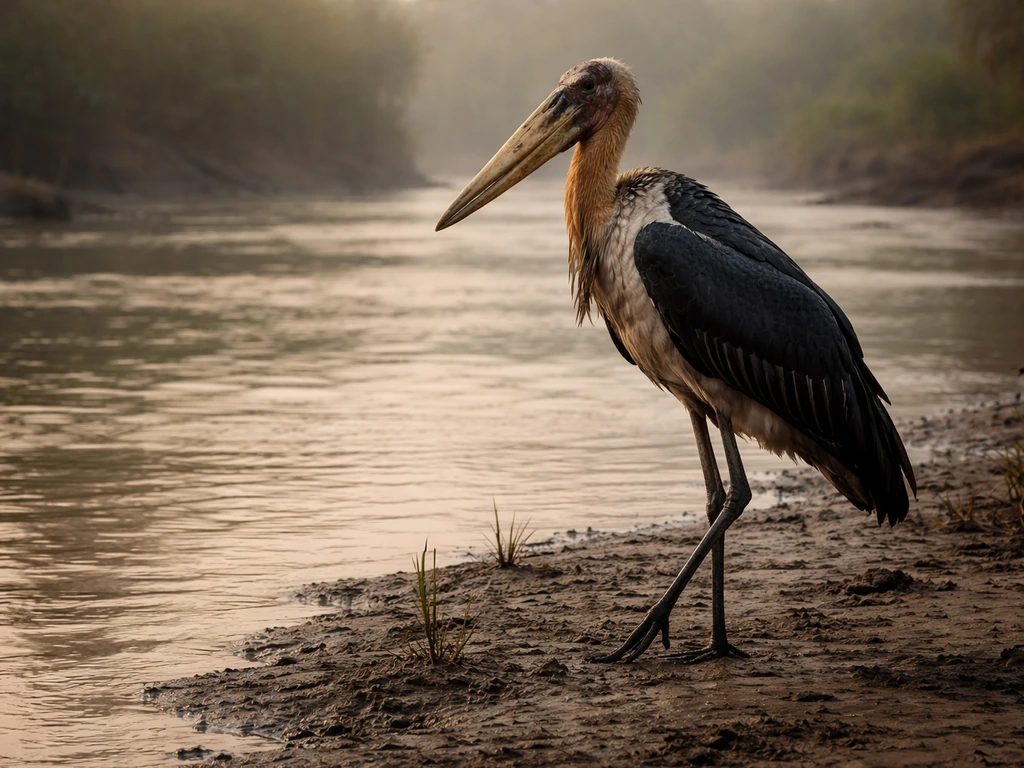
When someone says 'adjutant bird,' they almost always mean one of the large, bare-headed storks in the genus Leptoptilos, most commonly the Greater Adjutant (Leptoptilos dubius) or the Lesser Adjutant (Leptoptilos javanicus). These are real, living birds, not a metaphor or a forgotten military term. The name has been in use since at least 1809 and was coined because the bird's stiff, upright, slow-paced walk looked uncannily like a military officer on parade. Figuratively, 'adjutant bird' carries layered meanings depending on region: in parts of India it's a bad omen and a scavenger associated with death, while in other traditions it's connected to Garuda, the divine bird of Hindu mythology. If you've seen the term in a caption, book, or conversation and weren't sure what bird or meaning was intended, this guide gives you a direct answer and a way to confirm it for your specific context. That helps you interpret the phrase correctly when someone asks about butler bird meaning adjutant bird.
Adjutant Bird Meaning: Definition, Species, and Symbolism

What 'adjutant' actually means as a word

The word 'adjutant' comes from Latin adiutantem, rooted in a verb meaning to help or assist. In English it's been in use since around 1600, almost exclusively as a military title. In British and Commonwealth armed forces, the adjutant is the principal administrative staff officer attached to a commander, handling the paperwork, orders, and coordination that keep a battalion or regiment running. Think of it as the senior organizer behind the commanding officer: essential, efficient, and always present but rarely in direct command. Merriam-Webster frames it simply as a military officer who assists superior officers with administration, and that assistant/helper quality is baked into the word's DNA right back to its Latin roots.
That background matters for understanding the bird name, because the connection is purely visual and behavioral, not symbolic at origin. Someone in the early 19th century watched a large stork walking slowly and stiffly across a field and thought it looked exactly like a military adjutant pacing the grounds. To understand avis meaning bird, it helps to know how the Latin word avis relates to birds in general. The name stuck.
Which bird (or birds) people actually mean
The term 'adjutant bird' covers several species in the genus Leptoptilos, a group of very large tropical storks. There are two birds you'll encounter most often under this label:
| Common Name | Scientific Name | Range | Key Features |
|---|---|---|---|
| Greater Adjutant | Leptoptilos dubius | Assam (India) and Cambodia primarily | Larger, critically endangered, bare pink head and neck, massive bill |
| Lesser Adjutant | Leptoptilos javanicus | South and Southeast Asia | Slightly smaller, also bare-headed, more widespread |
Merriam-Webster's own definition acknowledges this ambiguity by covering 'several' Leptoptilos species rather than pinning the common name to a single bird. That's why the same term can appear in a wildlife book about India referring to the Greater Adjutant and in a Southeast Asian field guide referring to the Lesser Adjutant. Dictionary.com is even more direct, listing both Leptoptilos dubius and Leptoptilos javanicus as the two birds the name applies to. You'll also occasionally see 'adjutant stork' and, rarely, 'adjutant crane' used as alternatives, but they all point to the same Leptoptilos group.
What unites all these birds visually is a bare, featherless head and neck with pinkish skin, a posture reminiscent of vultures, a massive bill, and a slow, deliberate gait on the ground. Etymonline records a historical description from the Century Dictionary that perfectly captures the naming logic: the birds were said to have a 'stiff martinet air,' meaning they moved with the rigid, formal bearing of a strict military disciplinarian. Once you've seen one walk, the name makes perfect, immediate sense.
Symbolism and meaning in folklore and culture
The adjutant bird's cultural symbolism is rich, and it cuts in more than one direction depending on where you are.
The 'bone swallower' and its reputation as a bad omen
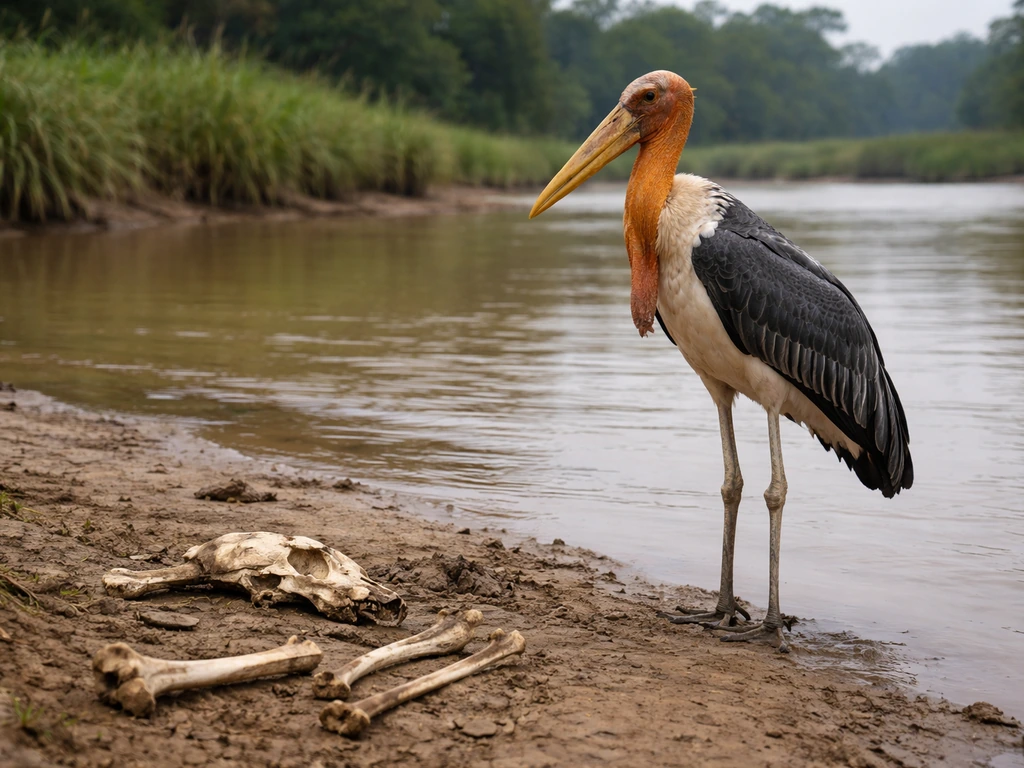
In Assam and Bengal, the Greater Adjutant is locally known as 'hargila,' which translates directly from Bengali and Assamese as 'bone swallower' (har = bone, gila = swallow). That name alone tells you how locals historically perceived the bird: as a creature that feeds on the dead, swallowing bones and carrion without hesitation. Time has reported that locals once viewed the Greater Adjutant as a bad omen, a pest, and even a disease carrier. It's a scavenger, feeding on carrion as well as small aquatic animals and snakes, and its bald head and hunched posture reinforce an association with death and decay that appears across multiple South Asian communities. In that cultural context, seeing an adjutant bird was not considered a good sign.
The Garuda connection in Bihar
Here is where the symbolism gets more complicated. In parts of Bihar, the Greater Adjutant is called 'Garuda,' the name of the mighty eagle-like bird in Hindu mythology who serves as the vahana (divine mount and vehicle) of Lord Vishnu. Garuda is one of the most powerful birds in the Hindu tradition, a symbol of divine power, speed, and protection. Connecting a large scavenging stork to Garuda might seem surprising, but large, imposing birds with bare skin and dramatic silhouettes have historically been mapped onto powerful mythological birds across many cultures. The association is regionally specific and doesn't cancel out the bad-omen interpretation elsewhere; it simply shows that bird symbolism is always local first.
From stigma to conservation symbol

In a striking modern reversal, the Greater Adjutant has become a conservation symbol in Assam, driven by a grassroots movement called the Hargila Army, a community conservation effort documented by National Geographic and Cornell Lab of Ornithology. The bird that was once a bad omen has been reframed as a natural heritage species worth protecting. That cultural shift is itself a kind of symbolic meaning: the adjutant bird has come to represent the possibility of changing how communities see animals they once feared or despised. Cornell Lab connects 'hargila' as a word and concept directly to the Greater Adjutant, and the film of the same name brings that conservation story to a wider audience.
Adjutant bird in idioms, slang, and figurative language
Unlike well-traveled bird idioms (the albatross around one's neck, for instance), 'adjutant bird' has not crossed over into mainstream English slang or fixed idiomatic phrases. If you meant the phrase "albatross" instead, this article can also explain the albatross bird meaning albatross around one's neck. You're unlikely to hear someone say 'don't be an adjutant bird' at a dinner table. However, the figurative thread does exist in a more subtle form. If you’re wondering about the alondra bird meaning, this same mix of cultural association and visual impression is often what drives the term in different regions. Because 'adjutant' literally means an assistant or administrative helper, writers occasionally use the adjutant bird as a literary image for a character or creature that serves, supports, or attends on another: the loyal, diligent, somewhat unglamorous organizer working behind the scenes. That reading maps neatly onto the military adjutant role, and any writer who knows both meanings can exploit the double resonance deliberately.
In historical and colonial-era natural history writing, 'adjutant' was also used admiringly in a wry way, mocking the bird's solemn, bureaucratic appearance with gentle humor. Calling a large stork an 'adjutant' was itself a kind of figurative joke: here is nature's civil servant, moving through the landscape with officious gravity. That tone still echoes in how wildlife writers describe the bird today.
Adjutant bird vs. similar-sounding or similar-meaning terms
Because the word 'adjutant' is relatively uncommon outside military and ornithological contexts, it's worth clarifying a few points of potential confusion before you go any further.
- Adjutant bird vs. adjutant stork: These are the same thing. 'Adjutant stork' is the more formal version; Merriam-Webster lists it as a direct variant. If you see either phrase, it means a Leptoptilos species.
- Adjutant bird vs. adjutant crane: 'Adjutant crane' is an older and less accurate variant you might find in pre-20th-century texts. Cranes and storks are different families, but the confusion in historical naming was common. It still refers to the same Leptoptilos birds.
- Adjutant bird vs. 'avis' or 'albs': Generic Latin or abbreviated bird terms (like 'avis,' meaning bird) are unrelated to 'adjutant.' If you've encountered those terms in a different context, they don't carry the same military-naming or Leptoptilos connection.
- Adjutant bird vs. butler bird: The butler bird is a completely separate common name used in some regions for certain birds associated with a servant-like or attending role. The naming logic is similar (a bird that 'serves'), but the species and cultural meanings are entirely different.
- Adjutant bird vs. hargila: 'Hargila' is the local Bengali/Assamese name for the Greater Adjutant specifically. If you see 'hargila' in a caption or article, it confirms the species is Leptoptilos dubius, not the Lesser Adjutant.
The most practical disambiguation rule: if a text says 'adjutant bird' or 'adjutant stork' without specifying further, assume it means a Leptoptilos species. If it says 'greater adjutant,' it's Leptoptilos dubius. If it says 'lesser adjutant,' it's Leptoptilos javanicus. Regional cues (India/Assam versus Southeast Asia) usually confirm which one is intended even when the species name is absent.
How to confirm what 'adjutant bird' means in your specific context
If you've landed here because you saw 'adjutant bird' in a caption, a book passage, a social media post, or a conversation and you want to be sure of the intended meaning, here's how to verify it quickly and confidently.
- Check the region or country of origin. If the source is from India (especially Assam or Bihar), it almost certainly means the Greater Adjutant (Leptoptilos dubius). If it's from Southeast Asia, the Lesser Adjutant (Leptoptilos javanicus) is the more likely candidate.
- Look for a local name in the same caption or passage. 'Hargila' points directly to the Greater Adjutant. Any mention of 'bone swallower' as a translation confirms the same.
- Check for a scientific name. If the text includes 'Leptoptilos dubius' or 'Leptoptilos javanicus,' the ambiguity is fully resolved. Wildlife photography captions and field guides frequently include binomial names.
- Assess whether the context is literal or figurative. Is the text describing an actual bird in nature, conservation, or wildlife photography? Then it's a zoological reference to a Leptoptilos stork. Is it a piece of fiction, poetry, or an idiom you've never heard before? Check whether the author might be using 'adjutant' in its military-assistant sense metaphorically.
- Consider the publication date. If the text is from before 1900 and uses 'adjutant crane,' it still almost certainly means a Leptoptilos species, but the taxonomic understanding of cranes vs. storks was looser then. Don't read crane-specific symbolism into it.
- Use a cross-reference source. Merriam-Webster, Britannica, and Dictionary.com all have clear definitions of 'adjutant bird' that confirm the Leptoptilos connection. Cornell Lab's 'Hargila' page is a particularly useful resource if your context involves conservation or South Asian cultural references.
The bottom line is that 'adjutant bird' is a straightforward zoological common name with a satisfying etymological story behind it, a military officer's stiff walk, a bald head, and a solemn bearing made the name obvious to whoever coined it around 1809. The cultural meanings layered on top (bad omen, divine bird, conservation icon) are regionally specific and don't override the core identification. Once you know you're dealing with a large tropical scavenging stork from South or Southeast Asia, the rest of the meaning in your specific context becomes much easier to trace. If you are looking for the small town bird lawyer meaning, use the same context clues to interpret which adjutant bird or figurative sense the writer intended. If you're looking for the meaning of the andril bird, start by matching the bird described in your text or image to the correct adjutant stork species Once you know you're dealing with a large tropical scavenging stork from South or Southeast Asia.
FAQ
Is “adjutant bird” ever used as a metaphor, or is it always a real bird?
In most contexts it is not a metaphor, it is the common name for large tropical storks in Leptoptilos. If the text talks about hunting, scavenging, habitat, or a specific region like Assam, India, or Southeast Asia, that strongly signals the zoological meaning.
How can I tell whether the Greater Adjutant or Lesser Adjutant is intended?
If the caption or description includes a place name, it usually narrows the species: “Assam, Bengal, hargila” most often points to the Greater Adjutant, while many Southeast Asian sources listing an adjutant without “greater” often mean the Lesser Adjutant.
What visual or behavioral details should I check to confirm it’s an adjutant stork?
Look for descriptive physical cues: the bare, pinkish head and neck, massive bill, and slow ground-walking posture with a formal, upright stance. If those traits are mentioned or shown, it is very likely an adjutant stork rather than another crane-like bird.
What should I do if a source calls it “adjutant crane” or mixes terminology with other birds?
If the source uses “adjutant” but also mentions “crane” or “other wading bird” in a loose way, treat it as likely referring to the Leptoptilos group unless the text clearly contradicts the bald head, huge bill, and stork-like build.
When would “adjutant” in writing mean “assistant officer” rather than the bird?
Use the military origin only when the text is explicitly literary, like a character “attending,” “assisting,” or “organizing behind the scenes.” If the wording is about scavenging, carrion, or wildlife sightings, default to the animal meaning.
If the article only says “adjutant,” how do I avoid assuming the wrong species?
The common name can vary, but the species mapping stays consistent: “greater adjutant” corresponds to Leptoptilos dubius, and “lesser adjutant” corresponds to Leptoptilos javanicus. If neither qualifier is present, confirmation from the region mentioned in the text is usually the fastest route.
Why do I see conflicting symbolism, bad omen versus reverence, for the same bird?
Symbolism is region-specific, so don’t combine traditions into one universal meaning. For example, a bad-omen framing in parts of India can coexist with later conservation pride in Assam, so the setting and time period in the source matter.
What does “bone swallower” tell me about the meaning and which adjutant it refers to?
If you encounter “bone swallower” (hargila) or references to feeding on carrion and bones, that is a strong cue for Greater Adjutant in the local cultural layer. It can help interpret older texts and older captions that describe fear or disgust.
How do I interpret the modern conservation symbolism without losing the older “bad omen” context?
If the content discusses conservation efforts, community groups, or a shift from fear to protection, treat that as modern symbolic meaning rather than the older “omen” layer. It reflects changing human attitudes toward the species in that area.
Is “adjutant bird” a fixed English expression like “albatross around one’s neck”?
Don’t treat “adjutant bird” as a common English idiom. If someone uses it figuratively in a story, it is usually a deliberate choice that relies on the adjutant idea of serving or assisting, so the surrounding plot cues are your best guide.
Actuary Bird Meaning: Symbolism, Variants, and Interpretation
Explains actuary bird meaning, likely mishearings, bird symbolism, and how to interpret it in speech or dreams.