
When someone searches 'avis meaning bird,' they are almost always chasing one of three things: the Latin root word avis, which literally means 'bird' and is the origin of several modern terms; the Spanish and Portuguese word aves, which is the plural of 'bird' and gets confused with avis constantly; or the female given name Avis, which does derive from Latin avis and does carry a bird meaning. In rare cases the word shows up in spiritual or omen-related contexts because ancient Latin speakers used avis to mean not just 'bird' but also 'sign' or 'omen.' The car rental brand Avis, meanwhile, has nothing to do with birds at all.
Avis Meaning Bird: What It Means and How to Identify It

Marcus Winters
21 Jun 2026
Where 'avis' comes from and what it originally meant
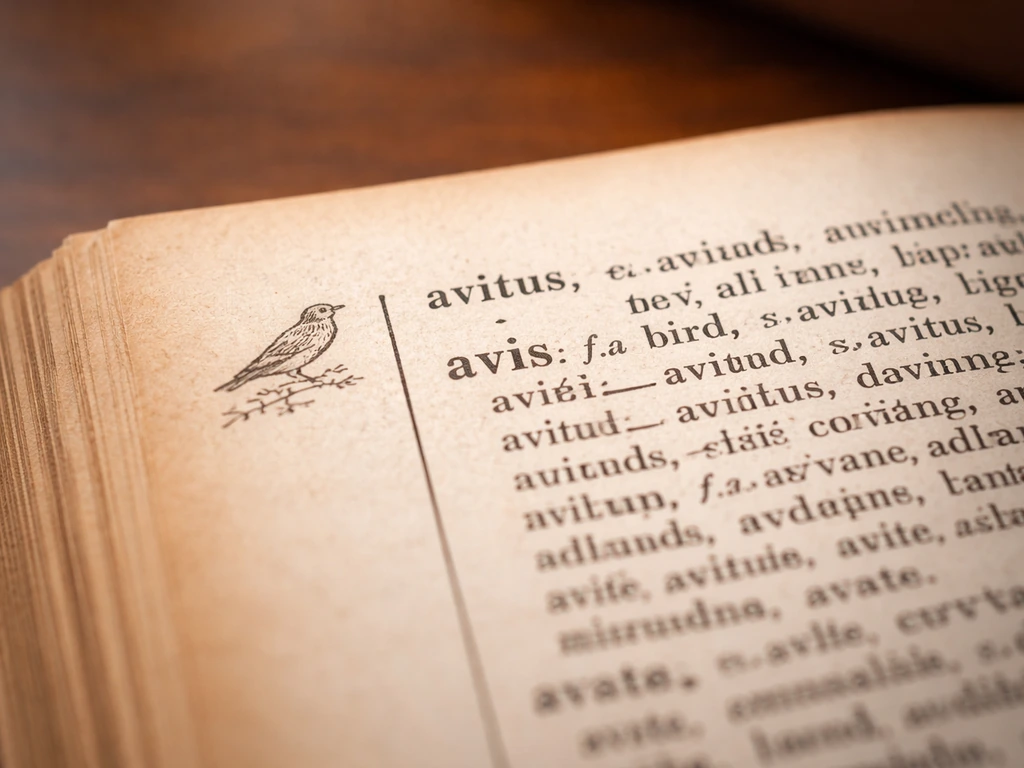
Avis is a Latin word, and in classical Latin it is a feminine noun meaning simply 'a bird.' That is the clean, literal starting point. Latin dictionaries list it as the root behind a whole cluster of English words you already know: aviation, aviary, avian, and avifauna all trace back to this single Latin root. So when you see 'avis' in a biological or technical context, it is almost always pointing straight back to that Latin origin.
The interesting wrinkle is that Latin also extended the meaning of avis into the domain of omens. Because the ancient Romans read signs and prophecies from the behavior of birds, the word avis took on a secondary figurative sense: a sign, portent, or omen. A bird flying from the right was a good avis; one from the left was a bad avis. This is also where the word 'auspice' comes from, built from avis plus specere ('to look at'). So the Latin word avis carries both a literal meaning (a bird) and a deeply embedded figurative one (an omen or sign), and both are genuinely ancient usages.
Is 'avis' actually a bird name or a bird word in everyday use?
In modern everyday language, avis is not a common bird word in English, Spanish, French, or Portuguese. You will not hear a native speaker of any of those languages casually use 'avis' to mean 'a bird' in daily conversation. In English it survives mainly inside scientific and technical vocabulary. In French, the word avis has completely shifted meaning: it now means 'opinion,' 'notice,' or 'piece of advice,' and has nothing to do with birds in modern French usage at all. The French phrase 'c'est mon avis' means 'that is my opinion,' not anything bird-related.
The name Avis is the main place where the bird meaning stays alive in living usage. blank" rel="noopener noreferrer">Avis as a female given name is directly borrowed from Latin avis and means 'bird.' It was fairly popular in English-speaking countries through the early twentieth century and still appears today. So if someone tells you their name is Avis, the etymology genuinely does mean 'bird.' WordReference and name etymology sources confirm this directly. The variant spelling Avice shares the same root.
The 'aves' vs. 'avis' confusion you need to sort out first

This is probably the single most common source of confusion when people search 'avis meaning bird,' and it is worth taking a moment to clear it up completely. In Spanish and Portuguese, the word for birds (plural) is aves, not avis. Aves is the direct descendant of the Latin word avis, but in Spanish and Portuguese it evolved into aves, which is also the scientific class name for all birds in taxonomy (Class Aves). The two words look almost identical in print, especially at a glance, and people frequently misread or misremember one as the other.
| Word | Language | Meaning | Example use |
|---|---|---|---|
| avis | Latin | A bird; also an omen or sign | Used in scientific/technical English terms like 'avian' |
| aves | Spanish / Portuguese | Birds (plural noun) | 'Las aves cantan' = 'The birds sing' |
| aves | Scientific taxonomy | Class of all birds | Class Aves in biology |
| avis | French | Opinion, notice, advice | 'C'est mon avis' = 'That is my opinion' |
| Avis | English (name) | Bird (by Latin etymology) | Female given name meaning 'bird' |
The quickest way to figure out which one you are dealing with is to look at the language of the source text. If the sentence is in Spanish or Portuguese and the word is 'aves,' it means birds. If the sentence is in Latin or is using technical/scientific language and the word is 'avis,' it means bird (singular) or omen. If the sentence is in French and the word is 'avis,' it means opinion. Context does most of the work here.
Phrases and idioms where 'avis' or bird-root words appear
Because avis fed directly into so much vocabulary, you will find its descendants showing up in idioms and phrases across several languages. The most important ones to recognize are worth knowing.
- Rara avis: This Latin phrase, meaning literally 'a rare bird,' is used in English to describe an unusual or exceptional person or thing. 'She is a rara avis in the industry' means she is remarkably rare. It comes directly from Latin avis and is still used in educated English writing today.
- Auspicious / under good auspices: Both come from avis via the Latin auspex (one who reads omens from birds). When you say a project got off to an 'auspicious start,' you are literally saying the birds gave a good sign.
- Augury: Another bird-omen descendant, from the Latin augur who read bird behavior as prophecy. 'A good augury for the future' traces straight back to avis.
- Aviary: A place that houses birds, directly from avis. Straightforward but worth noting as a live English descendant.
- Aviation / aviator: Flying like a bird, from avis. The connection between birds and human flight is baked into the word itself.
It is also worth noting that the phrase 'rara avis' sometimes gets written just as 'rare bird' in modern English, which is the direct translation of the Latin original. If you have explored related bird-term articles on this site, you will know that many bird-rooted expressions across different languages carry this same dual quality: they are simultaneously literal (about actual birds) and figurative (about human qualities or events). The adjutant bird, the albatross, and similar culturally loaded bird names all work the same way. The albatross is often discussed in symbolism and folklore, so it is useful to know what “albatross bird meaning” refers to in those contexts.
Bird symbolism connected to 'avis' and its omen meanings

Because avis carried both 'bird' and 'omen' meanings in Latin, the symbolism that clusters around it is essentially the symbolism of birds as messengers and signs across ancient Roman and broader Indo-European traditions. In the same way, the albs bird meaning is usually tied to an omen or sign concept that overlaps with how Latin avis was used. This is not symbolism tied to one specific bird species but rather to the act of reading birds as omens, which was formalized in Roman culture as augury.
In ancient Roman practice, specific birds held specific omen meanings. Eagles were the highest-status avis, associated with Jupiter and interpreted as signs of victory or divine favor. Owls were ambiguous: sometimes a sign of wisdom, sometimes a death omen depending on context and timing. Ravens and crows were carefully watched because their calls and flight patterns were believed to carry messages from the divine realm. Woodpeckers were sacred to Mars and considered a strong positive avis for warriors heading to battle. The key point here is that in Roman culture, a 'good avis' or 'bad avis' was not abstract. It was a real bird doing a real, observable thing that trained augurs interpreted according to a codified system.
This tradition fed into medieval European folklore and eventually into broader Western bird symbolism. The idea that birds carry meaning, warnings, or blessings is essentially the survival of the Latin avis-as-omen concept in folk memory. When someone today says a bird tapping on their window feels like a sign, they are working within a very old framework that the word avis itself helped encode into Western culture. In bird symbolism, the alondra bird meaning is often discussed as a message of change, visibility, and intuition.
When 'avis' is spiritual, folkloric, or slang, and when it is just a brand
If you encounter 'avis' in a spiritual or folkloric context, the most likely meaning is the omen or messenger sense inherited from Latin. In some modern folklore and online posts, the butler bird meaning is also tied to that same idea of reading signs in bird behavior. Tarot readers, astrologers, and writers working in neo-pagan or classical traditions sometimes use avis as a shorthand for 'bird as sign.' In that context, the question is not 'which bird?' but rather 'what did the bird do, and what does that action traditionally signal?' The omen-reading framework from Roman augury is the interpretive lens to apply.
In slang, avis does not have a widely established meaning in English, Spanish, or French. It does not function as a slang term for a specific bird the way, for example, certain bird nicknames function in regional dialects. If you see it in an informal or slang context, it is most likely either a personal name (the female given name Avis) or a reference to the car rental company Avis, which was founded in 1946 and takes its name from its founder, Warren Avis. In its “Avis” entry, Wiktionary lists the term as a French borrowed form and treats this specific usage as a name rather than as the bird word blank" rel="noopener noreferrer">Wiktionary’s “Avis” entry. For a related look at how birds are treated as meaning-carrying symbols in Latin-derived traditions, see the andril bird meaning discussion. The company's name does etymologically trace back to Latin avis since it is a surname derived from the given name, but Avis the brand has no intentional bird meaning or symbolism built into its identity.
The practical way to confirm which 'avis' you are dealing with is to run through a simple checklist based on context.
- Check the language of the source text first. Spanish or Portuguese 'aves' means birds. French 'avis' means opinion. Latin or scientific 'avis' means bird or omen.
- Check whether it is capitalized. Capitalized Avis in English almost always refers to either the personal name or the car rental brand.
- Check whether it appears in a biological or taxonomic sentence. 'Class Aves' or 'avian species' points to the scientific bird meaning.
- Check whether it appears near omen, sign, portent, or augury language. That is the Roman avis-as-omen sense in play.
- Check whether it appears in a name context. Someone named Avis carries the 'bird' meaning by etymology, even if they never think about it.
Once you run through those checks, the meaning of avis in any given context should resolve clearly. The word has a genuinely rich history and shows up in more places than most people expect, but the bird meaning is always the Latin root underneath all of it. Whether you are reading about Roman omens, exploring the etymology of a name, working through a Spanish text about wildlife, or just trying to figure out why a word looks vaguely familiar, that Latin avis sitting at the center of it all is your reliable anchor point.
FAQ
How can I tell if “avis” in a text is about a bird (root meaning) versus plural “birds” in Spanish or Portuguese?
If you see “avis” in a scientific or taxonomic sentence, it is most often the Latin singular meaning, a bird (or a bird-related term). A common pitfall is to assume it is plural like Spanish “aves.” When the surrounding text is about organisms, classifications, or Latin-based scientific naming, “avis” almost always stays tied to the singular root meaning, not to the Spanish or Portuguese plural.
What does “avis” mean in French, and how do I avoid confusing it with the Latin bird root?
In French, “avis” does not mean bird. It usually means opinion, notice, or advice, and it appears in everyday phrases like “un avis” (a notice) or “mon avis” (my opinion). If you are reading French and the sentence structure looks like you are being asked for judgment or a response, treat it as “opinion/notice,” not as any bird word.
When “avis” shows up in a spiritual or omen context, should I focus on the bird species or on the bird’s behavior?
If your “avis” is in a spiritual, omen, or symbolism context, the key is not the exact bird species but what action is being described. The Latin-derived concept points to reading birds as signs or messengers, so details like direction, timing, flight pattern, or behavior usually matter more than the word itself.
Does “rara avis” mean a specific rare species, or is it an idiom?
“Rara avis” is best treated as an idiom, meaning something rare or unusual. It is not a literal instruction to identify an actual rare species. Even if it appears alongside bird imagery, the phrase functions like English “rare bird,” and you should interpret it as a figurative label.
If “Avis” appears as a name, does it always mean bird, or could it refer to something else?
If “avis” is used as a personal name, it is usually connected to the female given name Avis, derived from Latin avis and carrying the bird meaning. Be cautious with similar-looking names like “Avice,” which are variants, but also remember that “Avis” could be a surname or brand name in other contexts.
Why does “avis” sometimes seem unclear in English, and when should I expect it to mean the bird root?
The Latin-to-English connections are strongest when “avis” appears inside longer words that already sound like technical vocabulary, such as aviation, aviary, avian, or avifauna. A common mistake is to hunt for “avis” in casual English speech where it is uncommon, then force-fit a bird meaning. If the term is not part of that root-family vocabulary, it might be French “avis” (opinion) or a name.
If someone claims an “avis” omen prediction today, what details should I look for to judge whether it matches the classical framework?
Roman augury traditions treated “good” versus “bad” signs as specific to observable events, not as abstract symbolism. So if a modern post claims “ovis” or “avis” predicts something, check whether it includes the kind of concrete observation augury relied on (for example, which bird, what it did, and timing). Without those details, it is more likely modern folk interpretation than classical usage.
Does the brand name “Avis” have any real bird symbolism or omen meaning?
The car rental company’s name does not create an intentional bird meaning in the way the Latin root does. The brand name traces to founder Warren Avis and behaves like a surname-derived name, so any bird symbolism you see online is usually added by commentators rather than built into the company’s etymology.
Next Article
Adjutant Bird Meaning: Definition, Species, and Symbolism
Clear adjutant bird meaning: definition, which stork species is meant, symbolism, and how to disambiguate by region.