
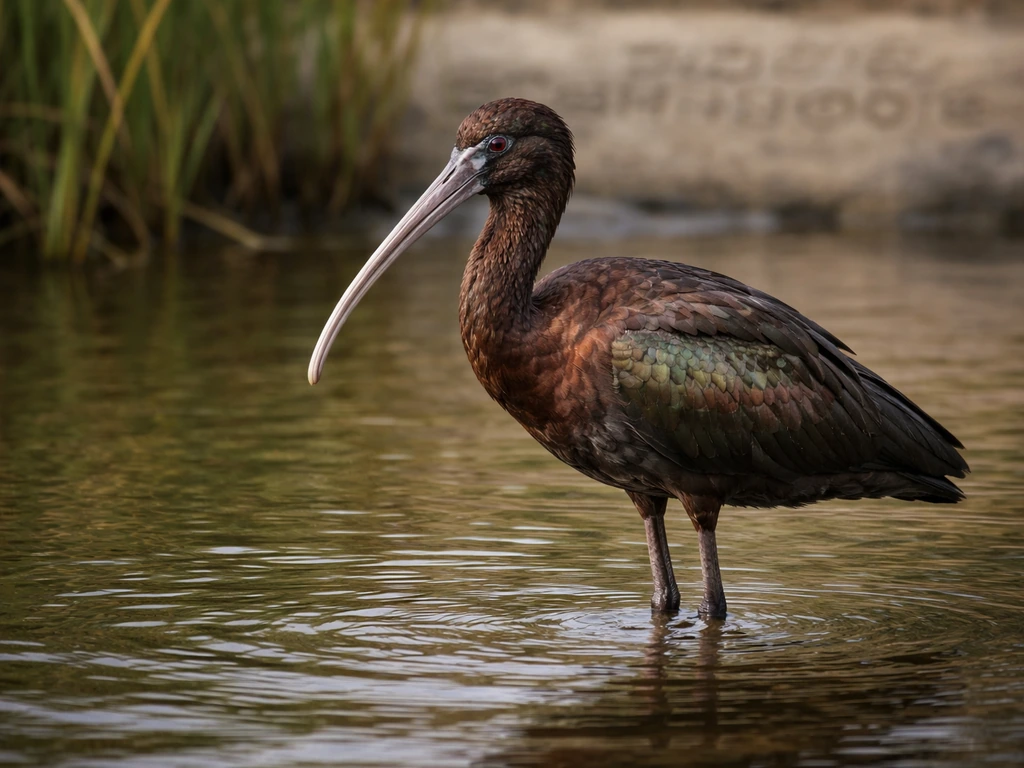
"Andril bird" almost certainly refers to the Glossy Ibis, a real wading bird species, through its Tamil name "அன்றில்" (transliterated into English as Andril, Anril, Anrill, or Antril depending on the source). In Tamil literature and culture, the Andril carries one of the most specific symbolic meanings attached to any bird: it is an icon of everlasting, faithful love. If you saw this word in a Tamil song, a poem, a heritage article, or a translated classical text, that is exactly what it means.
Andril Bird Meaning: Species, Nicknames, and Symbolism Guide

Marcus Winters
25 Jun 2026
What "Andril" Actually Means and How It's Spelled

The word comes from Tamil script "அன்றில்" and the challenge is purely a transliteration one. Tamil does not map perfectly onto the English alphabet, so the same word gets romanized differently depending on who is writing it. You will see Andril, Anril, Anrill, and Antril across different websites, PDFs, and song lyric discussions. All of them point back to the same Tamil word for the same bird. This is not a case of multiple birds having similar names. It is one bird with one Tamil name that gets spelled four or five different ways in English.
The scientific species behind the name is Plegadis falcinellus, the Glossy Ibis. It is a medium-sized wading bird with iridescent dark plumage that shifts between deep brown, green, and purple in different light. It is found across South Asia, including in the wetlands of Tamil Nadu, which is why it became embedded in Tamil literary tradition. The Tamil Wiktionary entry for the Glossy Ibis lists "அன்றில்" as the blank" rel="noopener noreferrer">primary term, alongside a couple of other Tamil names for ibis-type birds.
Real Bird, Nickname, or Slang? Sorting Out What You're Looking At
The Andril is a real bird with a real Tamil name, not a nickname, not slang, and not a made-up term. That said, it functions in figurative and literary ways that go far beyond its biological identity, which is why people search for its meaning rather than just its species. When someone in a Tamil song lyric sends an "Andril" as a messenger, or when a poem describes the Andril beside a lover, the word is doing double duty: it identifies the actual Glossy Ibis and simultaneously invokes a specific cultural symbol. Many readers look up the adjutant bird meaning to compare different bird-name symbolism, but the Tamil “Andril” in this context refers to the Glossy Ibis and everlasting love.
It is worth clearing up one confusion that trips up a lot of searchers. "Andril" is sometimes mixed up with "Andriel," which appears on baby name sites and in Tolkien-themed fantasy contexts as a name meaning "manly" or "warrior. The New Indian Express, covering Tamil music in 2020, framed the Andril as a glossy ibis whose appearance in Tamil literature "implies lasting love Andriel.
" Andriel is a personal name with no connection to birds or Tamil culture at all. If you found "Andriel" in a fantasy story or a name registry, you are looking at a completely different word. The bird term is specifically Andril, and it shows up in Tamil song lyrics, classical poetry translations, and heritage writing, not in fantasy fiction naming conventions.
The Cultural Symbolism: What the Andril Actually Represents

Tamil literary tradition uses the Andril as a symbol of lasting, devoted love. This is not a vague romantic association. The symbolism is quite specific: the Andril represents a love that endures, a bond that does not waver. INTACH Madurai, a cultural heritage organization, describes the Andril bird directly as "The Ibis: An Icon of Everlasting Love." The New Indian Express, covering Tamil music in 2020, framed the Andril as a glossy ibis whose appearance in Tamil literature "implies lasting love."
An Urban Dictionary entry under "Anrill" (another spelling variant) gives a street-level version of the same meaning, describing it as a kind of Indian love bird from Tamil literature and noting that lovers used the term to describe themselves and each other. This is consistent with how the bird appears in classical Tamil poetry, where it often acts as a messenger or a witness to a couple's devotion. Think of it as the Tamil literary equivalent of a dove in Western imagery, but more specific and more rooted in a real regional bird species that people in Tamil Nadu would have actually seen near water bodies.
The Glossy Ibis itself, as a species, reinforces the symbolism in a practical way. It is a bird often seen in pairs or small flocks near water. Its iridescent plumage makes it visually striking, the kind of bird that would catch a poet's attention. In the Sangam literary tradition, nature imagery including specific birds, flowers, and landscapes was used in a structured way to communicate emotional states. The Andril fits into that tradition as a creature associated with love and longing.
How Andril Connects to Other Bird Terms and Idioms
Bird symbolism in literature tends to cluster around a few universal themes: love, freedom, death, and divine messengers. The Andril sits firmly in the love-and-devotion cluster, which makes it comparable to how other cultures use specific birds in figurative language. The albatross, for instance, carries a very different weight in English-language tradition: it signals burden, guilt, and inescapable consequence. For the albatross bird meaning in English-language tradition, it is often linked to burden, guilt, and unavoidable consequence. The Andril's meaning is nearly the opposite, representing lightness, hope, and romantic constancy.
Within Tamil naming traditions, the word "Andril" is also used as a given name, particularly for girls, because of its association with beauty and love. This bridges the gap between bird symbolism and human identity, which is a pattern you see across many cultures. The way the Andril functions as both a species name and a name for people mirrors how terms like "avis" (the Latin root for bird) or regional bird names get absorbed into human naming conventions as carriers of positive symbolic weight. In Latin, avis simply means bird, which is the root behind many bird-related terms.
Where You're Most Likely to Encounter "Andril" Online
Most people searching for Andril bird meaning today are hitting it in one of a handful of specific contexts. If you are asking about the “small town bird lawyer meaning,” it is usually a misunderstanding of the Tamil “Andril” spelled differently in English. Here is where the term shows up and what it means in each place:
- Tamil song lyrics and music discussions: The most common encounter point. When a Tamil song uses the word Andril, it is invoking the love symbolism of the Glossy Ibis. Reddit's r/Chennai community has discussed exactly this, with commenters clarifying that Andril is a type of bird used in romantic lyric contexts.
- Classical Tamil literature and translated texts: Project Madurai, which digitizes Tamil classical texts, contains phrases like "an Andril bird climbed..." and "she sent an Andril bird..." These are poetic motifs where the bird acts as a messenger or an emotional metaphor in the original Sangam tradition.
- Heritage and cultural education content: Organizations like INTACH Madurai publish explainers specifically about the Andril as a cultural symbol, labeling it the ibis icon of everlasting love.
- Tamil given names: Andril is used as a name for girls in Tamil communities, and name-meaning searches sometimes collide with the bird-meaning searches.
- Tattoo symbolism searches: People researching Tamil cultural tattoos or ibis tattoo meanings land on Andril as part of understanding what a Glossy Ibis tattoo might represent in a Tamil cultural context.
- Usernames and social handles: Some Tamil speakers or Tamil culture enthusiasts use Andril as a username, drawing on the love symbolism of the term as a personal identifier.
If you found the word in a game or a Western fantasy story and it is not connected to Tamil language or culture, double-check the spelling carefully. As noted above, "Andriel" appears in Tolkien-adjacent naming contexts and means something entirely different. A single letter difference shifts you from Tamil ibis symbolism to fantasy warrior naming conventions.
How to Confirm the Exact Meaning Quickly
The fastest way to resolve what any specific use of "Andril" means is to check the context it came from against a short checklist. The butler bird meaning is often discussed online in connection with how people use bird names symbolically check the context it came from. Most ambiguity clears up in under a minute once you run through these questions:
- Is it in Tamil content? If the surrounding words are Tamil, the lyrics are from a Tamil song, or the source is a South Indian publication or heritage site, Andril means the Glossy Ibis with its lasting-love symbolism. That is the correct interpretation.
- Check the exact spelling. Andril, Anril, Anrill, and Antril all point to the Tamil ibis. Andriel (with an e before the l) points to a personal name, typically in fantasy or baby-name contexts, with no bird connection.
- Is it in a literary or poetic passage? If there are other nature images, references to water or wetlands, or romantic themes in the same passage, the Andril is functioning as a love symbol in the classical Tamil literary tradition.
- Is it from a game, fantasy novel, or fictional world that is not Tamil in origin? Then Andril is likely being used as invented terminology by that specific work, and you should look for a glossary or wiki for that property rather than treating it as a Tamil bird term.
- Is it a name rather than a noun? If Andril appears to be a character name or a person's name in a non-Tamil context, it may be a stylized version of Andriel or a completely independent invented name. In Tamil contexts, though, Andril as a name still draws from the bird's symbolism.
- Search the platform directly. If you saw it on Reddit, look at what subreddit it appeared in. If it is r/Chennai, r/Tamil, or a music-related sub, the Tamil ibis interpretation is almost certainly correct.
The Quick Comparison: Andril vs. Andriel

| Term | Origin | Meaning | Context Where You'll See It |
|---|---|---|---|
| Andril (also Anril, Anrill, Antril) | Tamil (அன்றில்) | Glossy Ibis; symbol of everlasting love | Tamil songs, classical poetry, heritage writing, Tamil given names |
| Andriel | Fantasy/name tradition (possibly influenced by Tolkien) | Manly, warrior; a personal name | Baby name sites, fantasy fiction, non-Tamil naming contexts |
Once you confirm the Tamil origin, the meaning is consistent across every source: the Andril is the Glossy Ibis, and in Tamil cultural tradition, it stands for a love that lasts. That is a clean, direct symbolic meaning with real roots in classical literature and a recognizable species behind it, which puts it in the same category as culturally grounded bird symbolism you find across traditions worldwide, just through a Tamil lens most English-language resources have not documented particularly well until recently.
FAQ
How can I tell if “andril bird meaning” refers to the Tamil Glossy Ibis or something else?
It usually does, because the Tamil bird term is tied to the word form from அன்றில். If the spelling you see is close (Andril, Anril, Anrill, Antril, Anrill), and the text is Tamil, Tamil music, or a Tamil literature translation, it is almost always the Glossy Ibis with the everlasting love symbolism. If the spelling is “Andriel” and the context is baby-name lists or fantasy, treat it as a different word entirely.
In a Tamil song lyric, what context indicates that Andril means “everlasting love” rather than just the bird species?
The symbolism is strongest when “Andril” is used as a poetic companion, messenger, witness, or emblem beside a lover. If it appears in a line about devotion, waiting, or a bond that does not fade, that is the context where everlasting, faithful love is intended, not just “a bird.” If the line is purely descriptive of wetlands or sightings, the symbol may be muted or absent.
Why do multiple spellings (Andril, Anril, Anrill, Antril) show up, and what is the best way to verify the exact word?
For romanization, you should search by both spelling variants and the Tamil script. If you can find the original Tamil characters (அன்றில்), you can eliminate nearly all ambiguity from English-only sources. Without the Tamil script, rely on the cultural setting (Tamil literature, Sangam-style imagery, Tamil Nadu wetlands) to confirm it is the same term.
If Andril is used as a given name, is the meaning the same as the bird meaning?
Andril can function in two ways depending on where it appears. As a bird term, it refers to the Glossy Ibis and evokes lasting love in literary usage. As a personal name (commonly for girls), it borrows that positive association, so the “meaning” people report is symbolic rather than literal bird identification.
Is “Andriel” the same as “Andril” and does it share the same bird meaning?
Yes, a common mix-up is with “Andriel,” which is often treated as a personal name with warrior or manly associations in fantasy-adjacent contexts. If you see “Andriel” specifically on baby-name sites, Tolkien-themed threads, or unrelated fantasy character pages, do not map it onto Tamil ibis symbolism. Even one-letter differences can shift the intended origin completely.
When people say “Andril is the ibis,” does the species name matter, and what is the Glossy Ibis scientific ID?
The intended bird is Plegadis falcinellus, the Glossy Ibis. That matters because symbolism is attached to the Tamil term for this ibis-like bird, not to generic words for “bird” or any wading bird. If a source claims a different species while still insisting it is “Andril,” treat it as likely an error in identification.
What should I do if “Andril” appears in an English game or fantasy story with no Tamil context?
If someone uses “Andril” in a non-Tamil setting, such as an unrelated game item description or Western fantasy writing, assume it might be borrowed as a stylized name rather than the Tamil bird. Your quick check is whether the surrounding text includes Tamil language cues, Tamil cultural references, or a translation note. If none are present, default to “name-only” usage rather than “Tamil symbolism.”
What is the fastest checklist to confirm the intended meaning of “Andril” in a specific text?
If the word is written in Latin letters only, ambiguity increases. A good decision aid is to check (1) the source type (Tamil literature discussion, song lyric translation, heritage article), (2) the nearest topic words (love, devoted bond, lovers, messenger), and (3) whether the Tamil spelling could plausibly be அன்றில் based on the exact romanization. When those align, the meaning is usually consistent.
Next Article
Avis Meaning Bird: What It Means and How to Identify It
Disambiguate avis meaning bird: origins of avis, common confusion with aves, and how to identify the right context and s