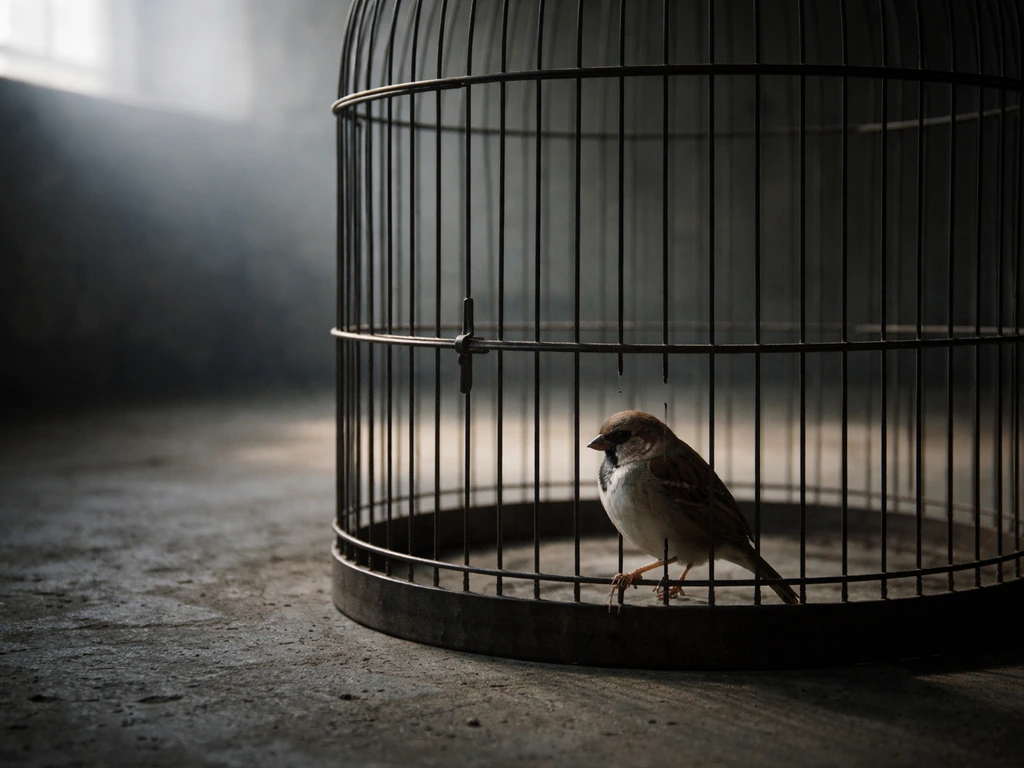
A jailbird (also written 'jail bird') is a person who has been in prison or jail, especially someone who has done time repeatedly. It's an informal, slightly old-fashioned English idiom used to describe a convict, ex-convict, or habitual criminal. You'll hear it in news commentary, movies, and casual conversation, usually with a tone that ranges from gently mocking to openly derogatory depending on who's saying it and why. People also search for the phrase "speak now bird cage meaning" as a clue to how the cage metaphor is used in language and media jailbird.
Jail Bird Idiom Meaning: What It Really Means

Marcus Winters
6 Jun 2026
What 'jailbird' actually means, in plain English
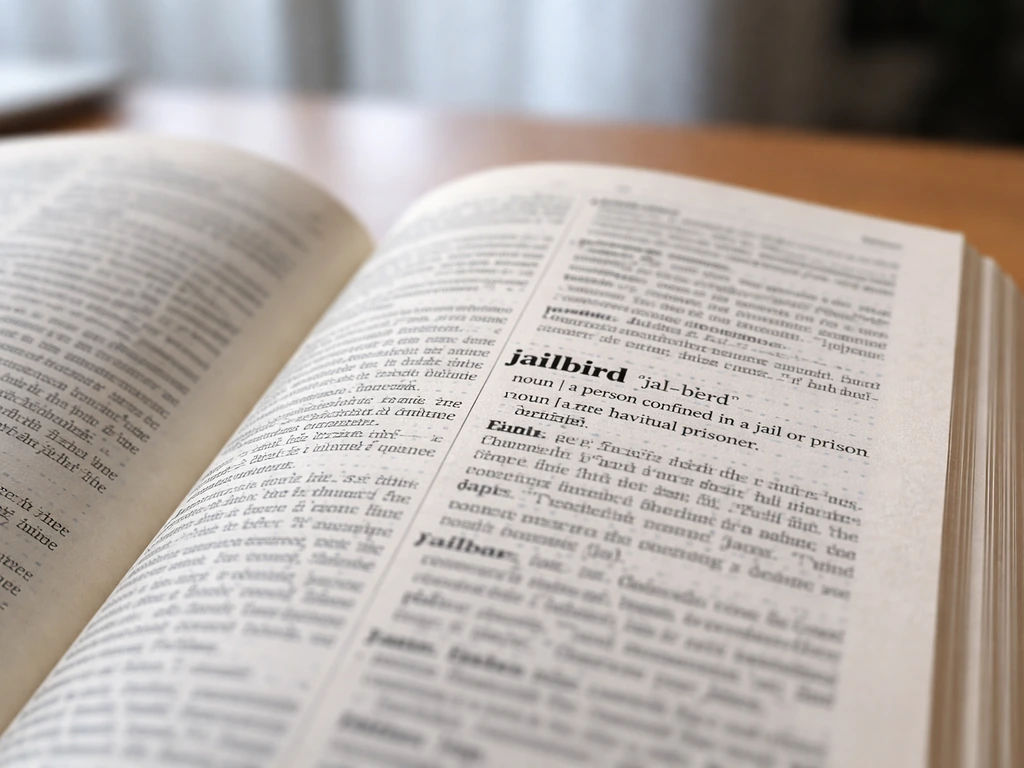
Every major dictionary agrees on the core definition. Dictionary.com calls a jailbird 'a person who is or has been confined in jail; convict or ex-convict.' Cambridge says it's informal (and in the UK, old-fashioned) for 'a person who has been in prison.' Merriam-Webster goes a step further, defining it as 'a person confined in jail' and 'especially: a habitual criminal.' That last part matters: jailbird carries a faint suggestion that this isn't the person's first time around. It's not always meant that way in casual use, but the undertone is there.
Britannica's entry adds 'often been in jail or prison,' reinforcing the repeat-offender implication. So if someone calls another person a jailbird, they're not just saying the person was arrested once, they're painting a picture of someone whose relationship with the justice system is something of a pattern. Whether that's accurate or just a rhetorical jab depends entirely on context.
One practical thing worth flagging: people searching for 'jail bird' (two words) are almost always asking about the same idiom. The two-word spelling is a spacing variant, not a separate phrase, and it refers to the same figurative label for a person, not a literal bird inside a jail cell.
Why 'bird'? The slang history behind the word
This is the part most people find genuinely surprising. The word 'jailbird' goes back to at least 1603, with Merriam-Webster citing it as the first known use. Etymonline records the 1610s meaning as 'person serving a sentence in jail,' and traces the imagery directly to a caged bird. The logic is simple and vivid: a person locked in jail is like a bird locked in a cage. “Be like the bird” is a related quote whose meaning is often discussed through the lens of freedom and captivity, themes that connect back to the “jailbird” symbolism be like the bird victor hugo meaning. The word 'jail' itself historically shares roots with the idea of a cage or enclosure, so 'jailbird' is almost a poetic doubling of that cage metaphor.
There's also a separate thread of slang that reinforces 'bird' as prison-related language. In British rhyming slang, 'bird-lime' rhymes with 'time,' and 'time' has long meant prison time, as in 'doing time.' By 1857, 'bird-lime' was documented as rhyming slang for a prison sentence. That eventually shortened to just 'bird,' which is why British English still has the phrase 'do bird,' meaning to serve a prison sentence. Cambridge defines 'do bird' as UK old-fashioned slang for spending time in prison. So 'bird' and incarceration have been linked in English slang for centuries, through two separate but reinforcing routes: the cage imagery of 'jailbird' and the rhyming slang shorthand of 'bird-lime = time.'
If you've read about the symbolism of caged birds more broadly, this won't surprise you. The image of a bird trapped, unable to fly, is one of the oldest and most universal metaphors for captivity and lost freedom in human language and culture.
Tone and nuance: when it's casual, when it's cutting
Jailbird is labeled 'informal' across every dictionary that registers tone, and in the UK, most sources call it outright old-fashioned. That tells you something useful: it's not a neutral, clinical term. It sits somewhere between a news-headline shorthand and a dismissive jab, and which end of that spectrum it lands on depends on who's using it and how.
In media and commentary, jailbird is often used for rhetorical punch. Merriam-Webster's example sentences include lines like 'At no point has the jailbird shown contrition for her crimes,' which is clearly framed as criticism. Another example, 'these seven crooked cops are just the tip of the MSP jailbird iceberg', uses it as a pointed label in journalism. In both cases, the speaker isn't being neutral: they're editorializing.
It can also be used humorously. CNN's transcripts include wordplay like 'potentially jailbird pumpkin,' and a news story about a carrier pigeon smuggling cellphones into a prison was described with the joke that 'this jailbird won't be flying the coop anymore.' That's the lighter, pun-based end of the spectrum. Sesame Street even introduced a character with a 'jailbird dad' to address incarceration for young children, showing the word appears in everything from crime reporting to children's educational content.
The bottom line on tone: jailbird is almost never a neutral descriptor. It carries at minimum a slightly mocking or judgmental undertone, and in many uses it's openly derogatory. If you're writing or speaking about someone's incarceration in a context that calls for fairness or sensitivity, jailbird is probably not the right word.
How it shows up in real sentences
Seeing jailbird in context is the fastest way to calibrate how it works. Here are several authentic-style examples drawn from the kinds of uses you'd actually encounter:
- "He's a jailbird — third offense this year." (Casual, judgmental, implying a pattern.)
- "The movie follows a jailbird trying to rebuild her life after release." (Neutral-ish, narrative framing in a review or synopsis.)
- "Don't hire that jailbird — he can't be trusted." (Derogatory, used as a character attack.)
- "The senator called his opponent a jailbird, which his team quickly walked back." (Rhetorical/political use, clearly meant to wound.)
- "She laughed about being a one-time jailbird after the overnight arrest at the protest." (Self-deprecating use, lightening tone by owning the label.)
- "These crooked officials are just the visible tip of the jailbird iceberg." (Media usage, punchy and editorial.)
Notice how the word shifts in weight depending on who's applying it and to whom. A person calling themselves a jailbird as a joke is very different from someone hurling it as an accusation. When you encounter it in a movie, song, or social media post, look at who's speaking, who the target is, and whether the framing is sympathetic, comedic, or adversarial. That context tells you everything about the intended meaning.
Jailbird vs. related terms: how they differ

Jailbird isn't the only word in this space, and the differences between these terms matter if you're trying to understand or use them precisely.
| Term | Core meaning | Tone/register | Implies repeat offending? |
|---|---|---|---|
| Jailbird | Person who has been in jail/prison | Informal, old-fashioned, often derogatory | Yes, frequently |
| Ex-con | Former prison convict | Informal, somewhat neutral to stigmatizing | Not necessarily |
| Con | Current or former convict | Informal slang, fairly neutral in criminal contexts | No |
| Convict | Person found guilty and sentenced | Formal/legal, neutral to negative | No |
| Inmate | Person currently incarcerated | Neutral, institutional | No |
| Formerly incarcerated person | Person who served prison time | Person-first, respectful, formal | No |
The key distinction for jailbird is that it's the most figurative and most loaded of the bunch. Where 'inmate' or 'convict' describe legal status in relatively factual terms, jailbird borrows the caged-bird imagery to make a more editorial point. It's also the one most likely to imply a pattern of offending rather than a single incident. 'Ex-con,' by contrast, is built around the 'former' aspect and doesn't carry the same habitual-criminal undertone. 'Con' (short for convict) is plain slang without the bird symbolism or the repeat-offender implication.
If you're exploring related bird-and-captivity language, it's worth knowing the term connects to a broader cluster of bird idioms about confinement and freedom, similar in spirit to expressions around birds in cages or birds on wires, which use avian imagery to talk about restriction and the desire to escape it. If you are also curious about other odd phrases that use animals for imagery, you can look up the bird on a wire rat in a pocket meaning to compare how such slang works. That same imagery is also behind the phrase bird in cage with door open meaning, where “open” signals a narrow window for freedom even while restraint remains birds in cages.
When to avoid 'jailbird' and what to say instead
If you're writing a casual op-ed, a crime comedy script, or quoting a historical source, jailbird is usually fine, readers will understand the register. But there are situations where it's the wrong call, and it's worth being clear about those.
Journalism, social work, legal writing, and any context involving real people and their reintegration into society all call for more neutral, person-first language. The Emerson College language guide recommends phrasing like 'person who was formerly incarcerated' or 'person recently released from prison.' The National Institute of Justice style guide suggests 'person convicted of a crime' instead of terms like 'convict' or 'ex-convict,' and 'person incarcerated' instead of 'inmate.' The Bureau of Justice Assistance echoes this with 'individual who was formerly incarcerated.'
The underlying principle is simple: jailbird reduces a person to their worst moment (or moments) in a way that more neutral terms don't. That might be exactly what a satirist or screenwriter wants, the term has genuine rhetorical punch, but in contexts involving real individuals, fairness, or rehabilitation, it stigmatizes more than it informs.
- Use 'jailbird' in clearly informal, creative, or humorous writing where tone is already established.
- Avoid it in news reporting about real individuals, unless quoting a source directly.
- Skip it entirely in professional, legal, social work, or advocacy contexts.
- If you're unsure about the register of your piece, 'formerly incarcerated person' or 'ex-convict' are safer, clearer alternatives.
- When you encounter it in media or lyrics, treat it as a signal of editorializing or informal tone — not a neutral description.
One last practical note: if you're seeing 'jail bird' (two words) in a text and wondering whether it's literal or figurative, context is your guide. If the sentence is about a person who went to prison, it's the idiom. If someone is genuinely describing a bird that ended up inside a jail facility, like that carrier pigeon caught smuggling cellphones, the two-word form might be a deliberate literal-plus-pun usage. Either way, both spellings trace back to the same caged-bird metaphor that's been in English for over 400 years.
FAQ
Is “jail bird” (two words) ever literal, or is it always an idiom?
In most everyday writing, “jailbird” is figurative even if the spacing is “jail bird.” You should treat it as an idiom unless the sentence clearly focuses on an actual animal inside a jail (for example, “carrier pigeon” or “bird smuggling”).
When is it misleading to call someone a “jailbird” instead of describing the facts?
Because it often implies a repeat-offender pattern, “jailbird” can be unfair when the person’s record is unknown or the claim is about a single conviction. If you cannot justify that undertone, switch to a neutral term like “person who was formerly incarcerated” or “person convicted.”
Can I use “jailbird” for someone who is accused or awaiting trial?
No. “Jailbird” is not the same as “on bail,” and it should not be used for someone who is awaiting trial. If the context is pretrial or bail status, use terms such as “defendant,” “suspect,” or “person awaiting trial,” depending on what you mean.
Does “jailbird” feel different in UK English compared with US English?
In the UK, it is commonly described as old-fashioned and informal, and it may sound sharper or more dismissive in serious contexts. Also, British readers may recognize “bird” as prison shorthand, so the phrase can land as slang beyond just the single word “jailbird.”
What’s a good way to handle “jailbird” when I need to quote it in an article?
If you are quoting someone else, you can keep the term but add a short neutral clarification in your own voice, such as “(a slang term for a person who has been imprisoned).” That way you preserve the source’s tone without leaving readers to infer your agreement.
Could calling someone a “jailbird” create problems in online or workplace communication?
Yes, because it is loaded, it can be interpreted as harassment or hate-like stigma depending on platform rules. A safer practice is to avoid addressing an individual directly with it, especially in comments, posts, or workplace settings where neutrality matters.
If someone calls themselves a “jailbird” jokingly, does it always mean the same thing?
If you see “jailbird” used as a joke or self-description, it can mean the speaker is using it as a form of dark humor or reclaiming. Still, you should not assume the intent, the safest approach is to judge by speaker-target relationship and whether there is a sympathetic framing.
How does “jailbird” differ from “convict” and “ex-con” in tone and implication?
“Jailbird” is close to terms like “convict” or “ex-con,” but it is usually more figurative and more judgmental because of the caged-bird imagery and the repeat-offender undertone. If you need accuracy without the editorial sting, choose person-first wording.
Next Article
Prison Bird Meaning: Literal vs Figurative Interpretations
Understand prison bird meaning, from literal captive birds to figurative trapped feelings, with context clues and paraph