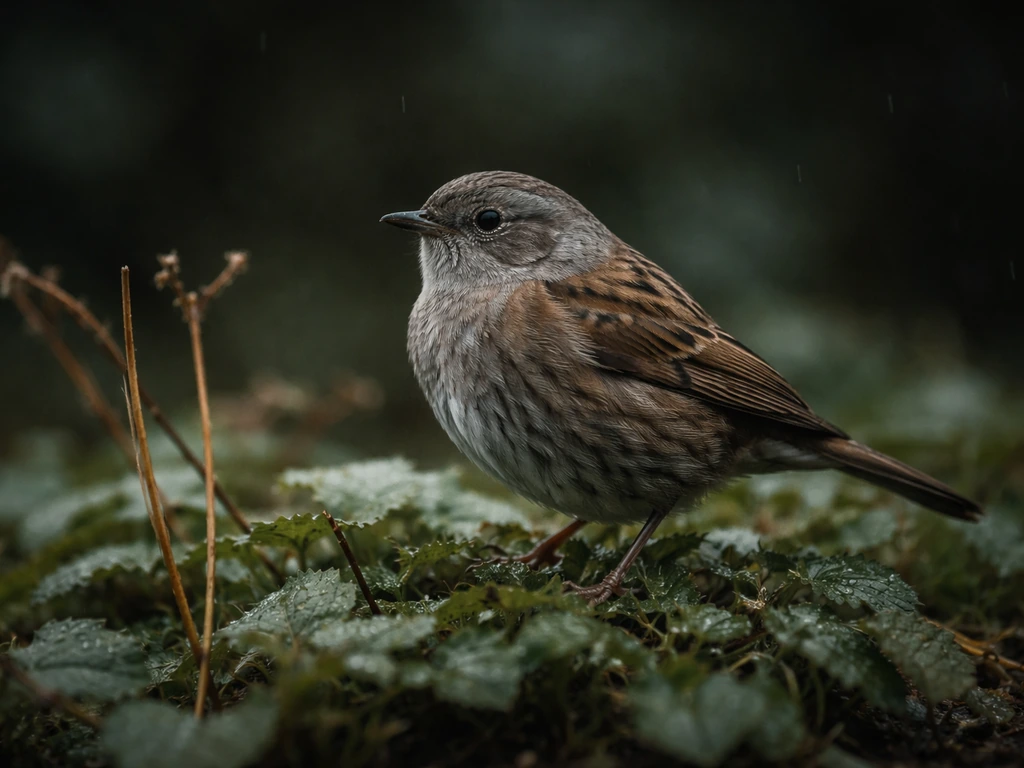
A jackdaw is a small, silver-and-black corvid with a reputation for being clever, social, and surprisingly bold. Symbolically, it carries meanings tied to intelligence, communication, community, and adaptability. Depending on where you look, a jackdaw can be a good omen of social connection and sharp thinking, a trickster figure, or a harbinger of change. If one showed up near your home, appeared in a dream, or popped up in something you were reading, you're in the right place to unpack what it likely means.
Jackdaw Bird Meaning: Omens, Folklore, Spiritual Signs

Marcus Winters
3 Jun 2026
What a jackdaw actually is (start here so the symbolism makes sense)
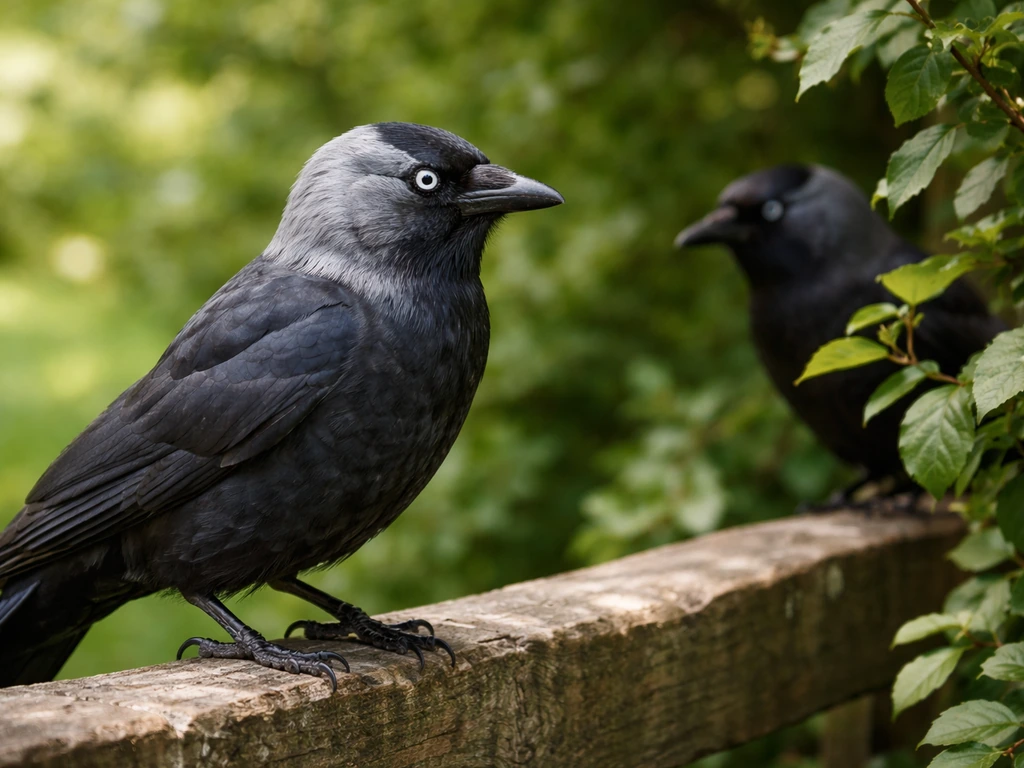
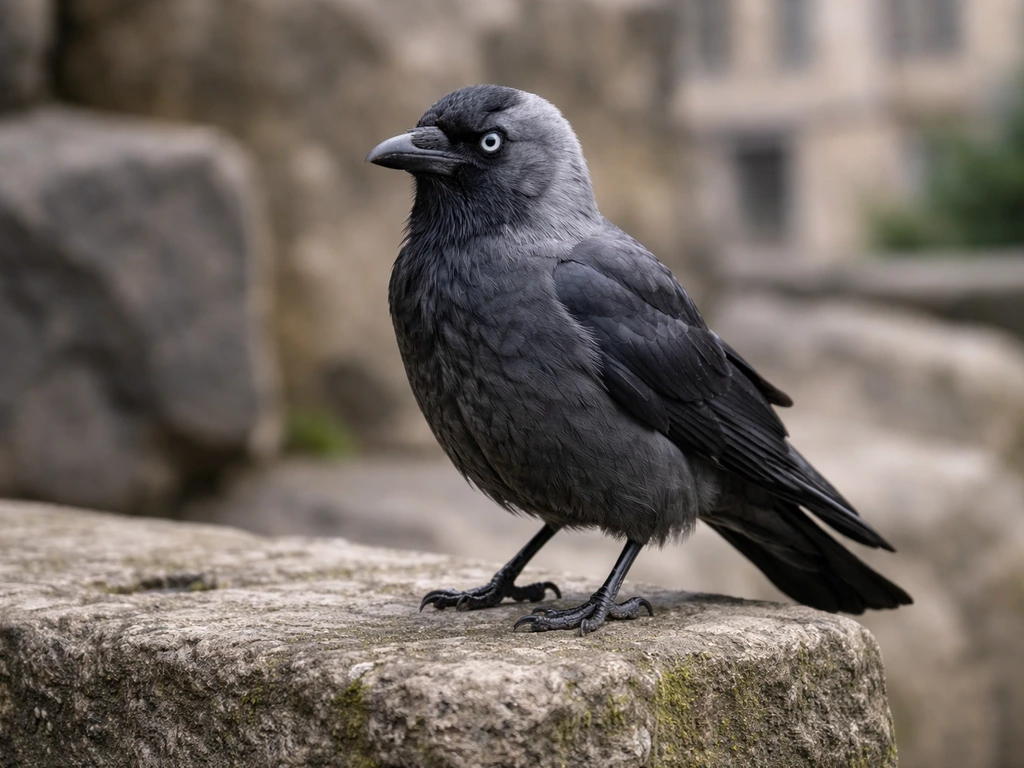
The jackdaw (Corvus monedula) is a member of the crow family, the corvids, and it's one of the smaller birds in that group. It ranges from the British Isles all the way through Europe and into central Asia. You can spot one by its silvery-grey nape and pale eye against a mostly black body. It's notably smaller than a rook or a carrion crow, which matters because the jackdaw's personality also punches above its weight.
Jackdaws are intensely social birds. They feed in flocks, roost communally, and often perform acrobatic aerial displays together, wheeling and diving in coordinated groups. Their call is a short, sharp 'kya' or 'tchack' (sometimes written as 'kjack'), which is where the 'jack' in the name likely comes from. Common Eurasian jackdaw calls can include “kya,” “kjack,” “tchack,” and the longer “kyaar,” as listed in the species’ sound description [“kya,” “kjack,” “tchack,” and the longer “kyaar”](https://www.
allaboutbirds. org/guide/Eurasian_Jackdaw/sounds). In the UK, they're the bird you hear clattering around church towers, old buildings, and chimneys, because those are exactly the kinds of cavities they love to nest in. Understanding that physical reality, a bold, noisy, social bird that moves in groups and makes its home in human structures, gives you the foundation you need to read the symbolism honestly.
Jackdaw symbolism across cultures and regions
Across most of its range, the jackdaw is associated with intelligence, watchfulness, and community. Being a corvid places it in very good company symbolically: crows, ravens, and rooks have all been cast as messengers, tricksters, and wisdom-keepers across cultures, and jackdaws share much of that symbolic DNA.
In British and Irish tradition, jackdaws are often linked to old sacred spaces, specifically churches and stone towers, which gave them an air of guardianship and mystery. The fact that they nest in ecclesiastical buildings wasn't lost on the people who lived near those buildings for centuries. In parts of Northern Europe, jackdaws were seen as birds that kept watch over the community, alert and vocal when anything changed. Their 'kya' alarm call reinforced this idea of a bird that speaks up and warns others.
In some Eastern European and Slavic traditions, jackdaws share symbolism with other corvids as birds associated with transformation and the movement between worlds. Their adaptability, thriving in both wild and urban spaces, gave them a reputation as birds that bridge the familiar and the unknown. In parts of central Asia, where the Eurasian jackdaw's range extends before being replaced by the Daurian jackdaw, similar themes of cleverness and social intelligence appear in folklore.
Jackdaws in folklore, mythology, and traditional belief
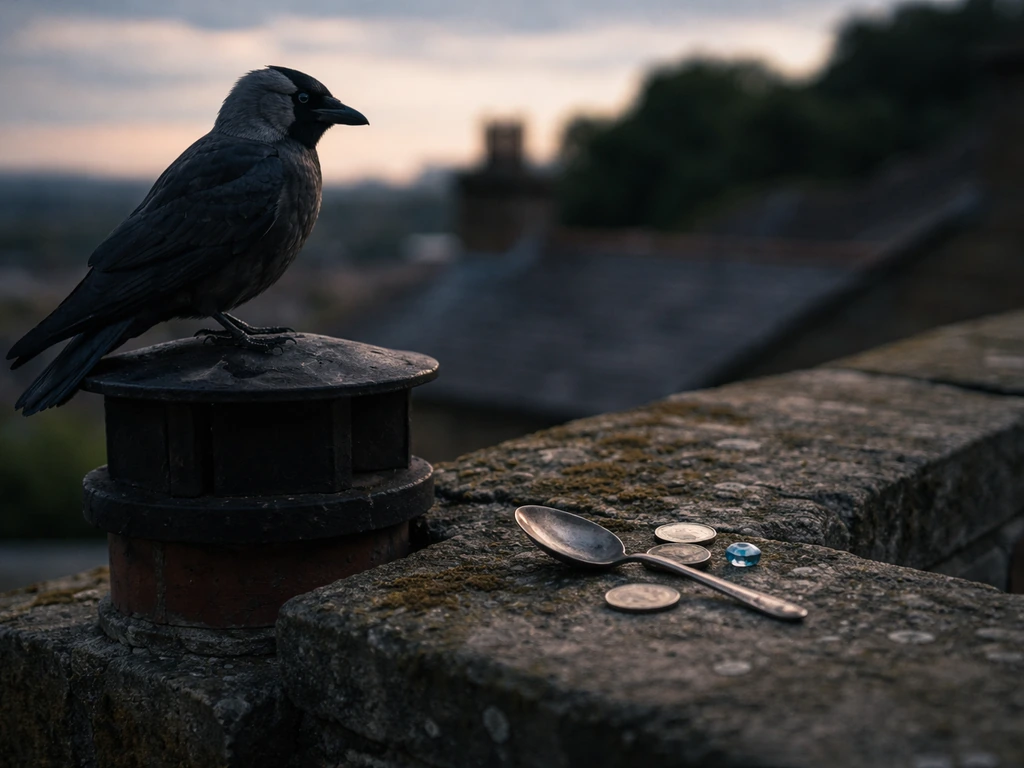
One of the most persistent folkloric themes around jackdaws is their association with theft and shiny objects. This appears across European traditions and was popularized in stories and operas (Rossini's 'The Thieving Magpie' is often confused with jackdaw folklore because both birds share this reputation). The idea is rooted in real behavior: corvids, including jackdaws, do investigate bright or novel objects. Symbolically, this translated into jackdaws being cast as collectors of hidden knowledge, things others overlook or discard.
In British folk belief, a lone jackdaw perching on a rooftop or chimney was sometimes read as a sign that a visitor was coming. This ties directly to the bird's biology: jackdaws actually do nest in chimneys, and their presence on a roof was a regular, noticeable event. The step from 'bird on the roof' to 'omen of arrival' is a short one in folk interpretation.
There's also a classical thread worth knowing. The Roman poet Ovid and others mentioned jackdaws in the context of garrulousness and gossip, birds that talk too much and reveal secrets. This is where the 'jackdaw as chatterbox' archetype originates, and it ran through European literary tradition for centuries. A jackdaw in an old story or fable almost always represents someone who talks too freely or reveals what should be kept quiet.
Good omen or bad? What a jackdaw appearance might mean spiritually
For most people asking about jackdaw meaning today, the question is really: is this a good sign or a bad sign? If you’re specifically looking for the dunnet bird meaning, it’s often treated as a related omen tied to symbolism and interpretation. The honest answer is that jackdaws lean positive in most symbolic frameworks, but context always matters.
| Situation | Common Interpretation | Lean Positive or Negative? |
|---|---|---|
| Single jackdaw lands near you | A visitor or message is coming; pay attention to who contacts you soon | Positive |
| Jackdaw calling repeatedly near your home | A warning or alert; something in your environment needs attention | Neutral/cautionary |
| Flock of jackdaws overhead | Community, collective energy, social connection incoming | Positive |
| Jackdaw nesting in or near your building | Long-term guardianship, stability, protection of the home | Positive |
| Jackdaw in a dream | Often signals sharp thinking needed, or a message from your subconscious about communication | Positive/reflective |
| Dead jackdaw | End of a cycle; release of old communication patterns or social ties | Bittersweet/transformative |
In spiritual and intuitive reading traditions, jackdaws are frequently associated with the throat chakra and the act of speaking up. If you keep encountering jackdaws, particularly if you notice their 'kya' call more than their physical presence, many readers would interpret this as a nudge to say something you've been holding back. The jackdaw is rarely a bird of silence.
The idea of jackdaws as messengers connects them loosely to traditions around the daw bird (the older English name for jackdaws), where any corvid-like bird at a threshold, a doorstep, a windowsill, a chimney, was considered a potential carrier of news from outside the ordinary. If you're looking specifically for down bird meaning, the symbolism also tends to connect to message, intuition, and what you might be sensing but not yet naming. If you've explored the meaning of the daw bird specifically, you'll recognize that jackdaw symbolism is essentially the fully developed version of that older, simpler archetype.
Jackdaws in language: idioms, metaphors, and what 'jackdaw energy' actually means
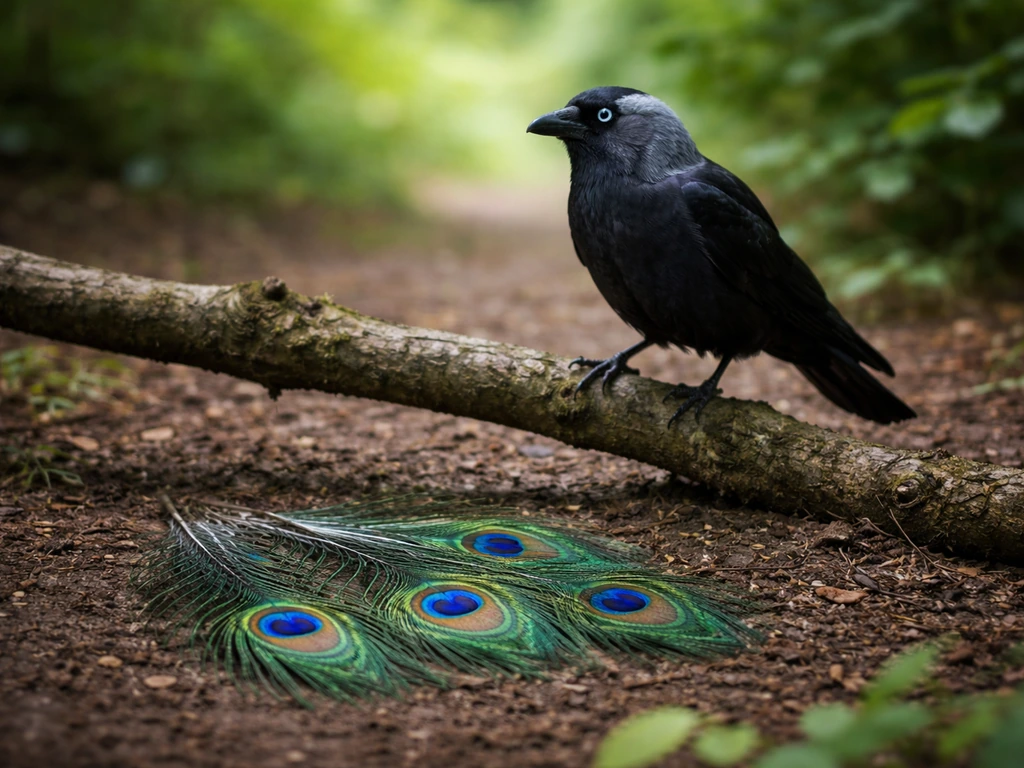
The jackdaw has punched well above its weight in the English language, especially in older literature and proverbs. Here are the most common figurative uses you'll encounter.
- 'Like a jackdaw in peacock's feathers' or 'the jackdaw in borrowed plumes': This comes from one of Aesop's fables and means someone pretending to be more impressive or important than they actually are. It's the original 'fake it till you make it,' but with a cautionary ending. If someone calls you a jackdaw in peacock's feathers, they're saying you're putting on airs.
- 'A jackdaw among crows': Used to describe someone who is out of place in a group, or conversely, someone who is smaller but equally capable in a crowd of more imposing individuals.
- 'Jackdaw talk' or 'chattering like a jackdaw': Means idle gossip, meaningless chatter, or talking without substance. Comes directly from the classical association of jackdaws with garrulousness.
- 'Jackdaw energy' (modern/informal): Used in contemporary spiritual and pop-culture contexts to describe someone who is intellectually curious, collects ideas and objects compulsively, is socially connected, and tends to be loud or communicative. It's generally used affectionately.
When someone uses 'jackdaw' as a metaphor today, they almost always mean one of two things: either a clever, sociable, curious person who collects knowledge or things (positive spin), or a chatty person who spreads information without always thinking about whether they should (negative spin). The tone of the conversation usually makes it obvious which one they mean. In the same way, “down” can be used in reference to a bird, so it is worth checking the specific phrase you saw for its intended meaning down meaning bird.
How to interpret jackdaw meaning for your specific situation
The most useful thing I can tell you here is to slow down and notice the details of your jackdaw encounter, because those details actually change the interpretation quite a bit. If you're also wondering about a down definition bird, consider how the phrase is used and what kind of meaning people are trying to give it. Here's a practical way to work through it.
- Identify the context first. Was this a real bird you saw? A dream? A reference in a book, film, or conversation? Real-world sightings and dream appearances use the same symbolic vocabulary but require slightly different interpretive lenses.
- Note the bird's behavior. A jackdaw that is calling loudly points toward communication and messages. A jackdaw that is watching quietly suggests observation and intelligence. A jackdaw in flight with others points toward community and belonging. A jackdaw alone is rarer and tends to read as a more personal, pointed sign.
- Notice where it was. Jackdaws near a home or chimney lean toward messages about hearth, family, or arrival of news. Jackdaws near a church or old building connect to older, more traditional symbolism around guardianship and sacred spaces. Jackdaws in an open field or sky are about freedom and collective energy.
- Check what's going on in your life right now. Symbolism lands on fertile ground. If you're in a period of decision-making about communication, relationships, or community, a jackdaw encounter is likely amplifying that theme. If you're in a stable period and a jackdaw simply showed up, it may just be a jackdaw.
- Decide whether to treat it culturally or literally. Not every bird sighting is a spiritual sign. Jackdaws are extremely common birds across their range, nesting in chimneys and gathering in flocks all the time. If jackdaws are part of your local environment, you'll see them often. That's fine. But if the encounter felt unusual, pointed, or arrived during a meaningful moment, then the cultural and spiritual frameworks above are worth applying.
If the jackdaw came up in language rather than in life, the fable of 'borrowed plumes' is probably the most relevant reference to know. It's a centuries-old shorthand for inauthenticity, and if someone used it around you, that's almost certainly what they meant. The idiom tradition around jackdaws connects loosely to similar language around other corvid-adjacent birds, including the meanings carried by terms like 'bird dawgs' and related expressions that have evolved their own separate figurative lives in modern slang. If you came across the phrase “bird dawgs,” it’s essentially another slangy way to point at the same social and chat-focused symbolism.
The bottom line: jackdaws are almost universally associated with intelligence, communication, community, and adaptability. They are more often a positive or neutral sign than a negative one. If you're drawn to jackdaw symbolism, the bird is probably asking you to think about who you talk to, what you share, and whether you're showing up authentically in your social world. In particular, people often search for the duke bird meaning to understand what the bird symbolizes in their own situation. If you’re wondering about the daft bird meaning, this same symbolism usually points to a blend of silly mischief and sharp social intelligence jackdaw meaning. That's a pretty useful message, whatever prompted the search.
FAQ
What is the most accurate “jackdaw bird meaning” if I saw one once, not repeatedly?
Most readers treat a single sighting as a general prompt, not a prediction. Focus on what you were doing or thinking at that moment, for example, a conversation you were about to have, a decision about community or collaboration, or a chance to share information. If you want a tighter reading, note the location (chimney, rooftop, street, park) and your emotional state when you noticed it.
Does “jackdaw meaning” change if the jackdaw was alone versus in a group?
Yes. A solitary jackdaw often gets read as a personal message (watchfulness, one-on-one communication, a need to speak up). Multiple jackdaws usually point to community themes, networking, social activity, or “group momentum,” since jackdaws are naturally flocking and communal in how they roost and display.
How should I interpret it if the jackdaw looked like it was collecting shiny objects?
In folklore this links to theft and shiny objects, but many modern spiritual readings refine it to “value and attention.” Ask what you have been overlooking, what you are chasing for novelty, or whether something is being taken from you in a metaphorical way (time, credit, ideas, or trust). If it happened near your work or home storage, the “collecting” theme often shifts toward resources and boundaries.
Is a jackdaw a bad omen if it makes its alarm call near my home?
Alarm calls are usually read as a warning to pay attention, not a guarantee of harm. Many interpretations frame it as heightened awareness, a heads-up about an incoming conversation or change, or noticing gossip or mixed signals. A “bad” meaning is less common unless the encounter overlaps with your own stress or a concrete concern you were already sensing.
What does “jackdaw meaning” have to do with gossip or secrets?
When the jackdaw appears in literature as chatty or secret-revealing, the symbolism is often about information ethics. If you keep associating jackdaws with gossip, a practical takeaway is to pause before sharing, check who might repeat your words, and consider what should stay private even if it feels tempting to vent or connect.
How do I interpret jackdaw symbolism in dreams, especially if the dream felt scary?
Dream jackdaws are commonly read as messages about communication (what you want to say, what you fear saying) or social dynamics (who is watching, who is spreading information). If the dream felt threatening, interpret it as internal self-talk rather than an outside event, for example, anxiety about being judged, outed, or misunderstood.
What if I only heard the “kya” or “tchack” and never saw the bird?
Many readers treat sound-only encounters as “intuitive timing.” The symbolism shifts toward speaking up, being alert to verbal cues, or noticing patterns in messages you are receiving. Try to recall what communication was on your mind when you heard it, such as a text, a meeting, or a difficult conversation.
Does jackdaw meaning differ by country or culture?
The core themes tend to stay similar (intelligence, watchfulness, community), but emphasis changes. In British and Irish contexts it often leans toward guardianship around sacred or old stone spaces. In some Eastern European traditions it leans toward transformation and threshold-crossing. If you’re applying meaning personally, choose the interpretation that matches your encounter context rather than picking a single tradition blindly.
What should I do with the jackdaw meaning in a “real life” way, not just symbolism?
Use it as a decision aid: pick one conversation, group, or shared project that you have been delaying. Then act in a small, concrete way, for example, reach out, clarify expectations, or speak one honest sentence you have been avoiding. If the jackdaw theme is gossip, set a boundary by sharing less or asking how information will be used.
Next Article
Dunnet Bird Meaning: Symbolism, Figurative Uses, and How to Verify
Meaning and symbolism of dunnet bird, plus tips to verify the exact species or metaphor in a specific text.