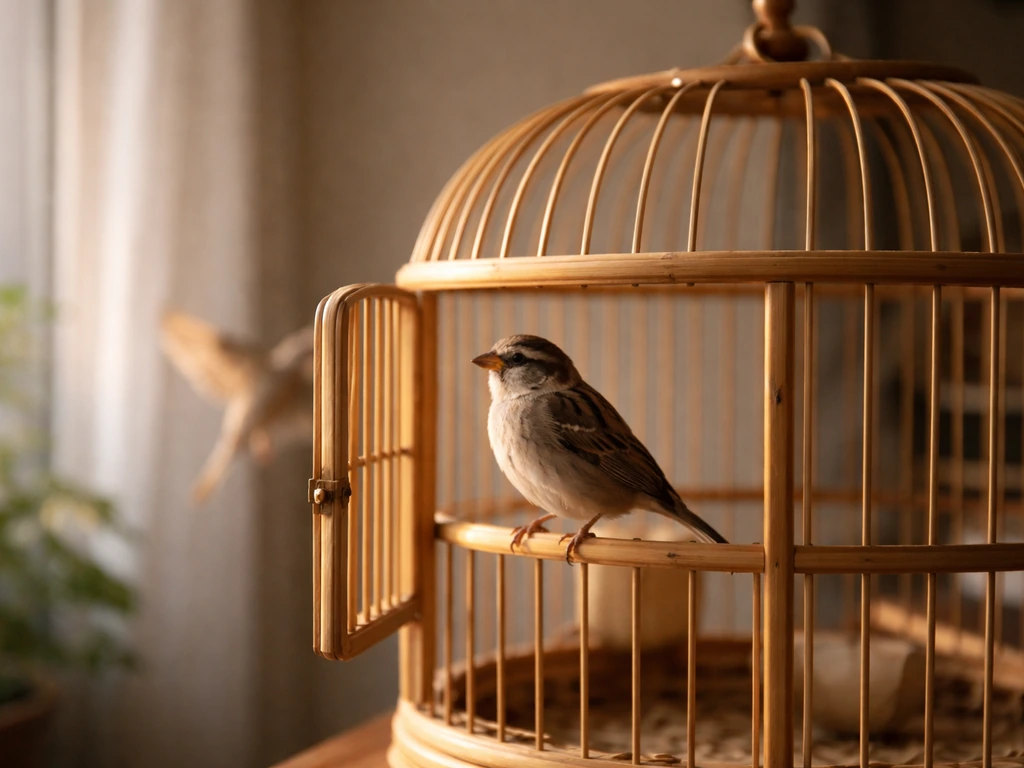
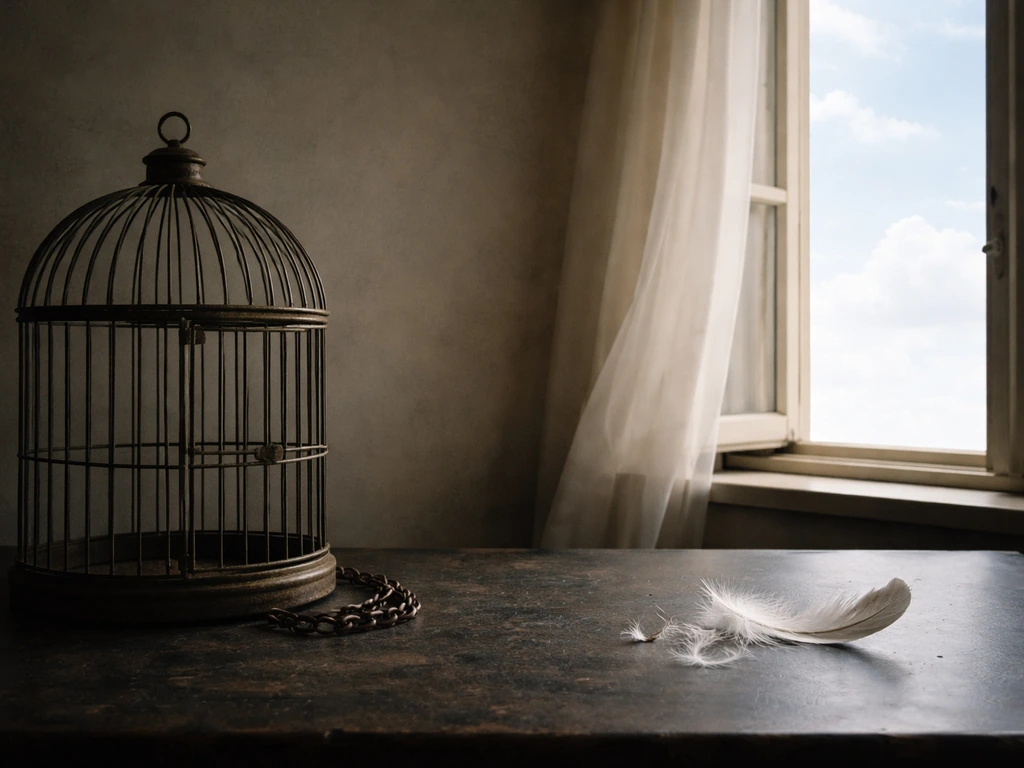
"I am a cage, in search of a bird" means something is built to contain, to hold, to give purpose to something else, but that something else is missing. The cage exists. The bird does not. It is a metaphor for longing, emptiness, and a kind of structured yearning: you have all the apparatus of meaning but none of the living thing that would make it real. The variant "a cage went in search of a bird" says the same thing but with more motion, more desperation, as if the emptiness itself has started walking.
I Am a Cage in Search of a Bird Meaning and Origin

Marcus Winters
2 May 2026
What the phrase means in plain English
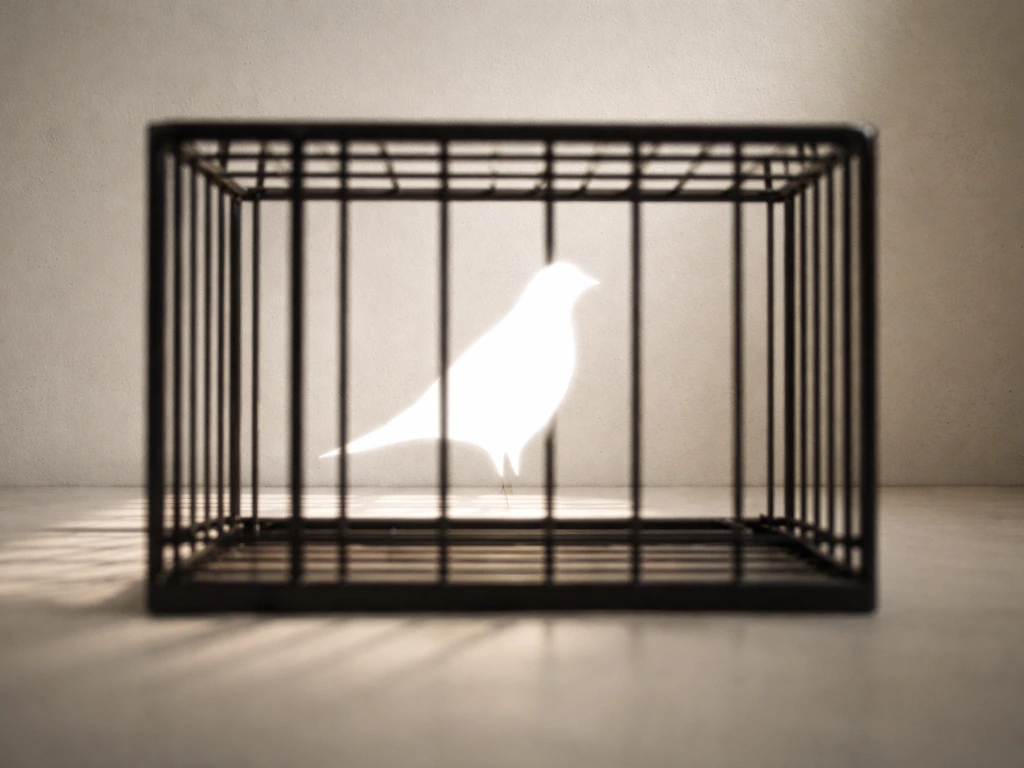
Strip away the poetry and you get this: something that is designed to limit or contain is wandering around looking for whatever it is supposed to limit or contain. That sounds almost comic when you say it plainly, and that tension between the absurd and the profound is part of what makes the line so striking. A cage without a bird is just wire and emptiness. It has all the shape of purpose without any of the substance.
In everyday terms, people reach for this phrase when they want to describe a feeling of being structurally ready for something that has not arrived yet. Think of someone who has built every condition for love, career, or creativity in their life, the house, the routine, the discipline, the ambition, but the actual animating thing, the spark, the person, the calling, is still absent. They are the cage. The bird is whatever would make it all feel alive.
It also works in reverse, and this is where it gets philosophically interesting. The phrase subtly asks: is the cage the victim or the aggressor? Is it pitiable for being empty, or sinister for going out looking for something to trap? That ambiguity is the heart of the aphorism. Both readings are valid, and the one you land on says something about how you are interpreting the situation.
Where the line likely comes from and why context matters
This line is almost universally attributed to Franz Kafka, specifically from a collection known as the Zürau Aphorisms. QuotePark also presents the first-person variant “I am a cage, in search of a bird” and attributes it to Kafka and the Zürau Aphorisms. Kafka wrote these short, compressed observations in 1917 and 1918 while staying in the village of Zürau (now Siřem, in the Czech Republic) recovering from tuberculosis. He wrote around 109 of them in that period. They were not published during his lifetime. When they finally reached readers, entry 16 stopped a lot of people cold.
Depending on which English translation you read, that entry appears as either "I am a cage, in search of a bird" or "A cage went in search of a bird. Wikiquote’s Zürau Aphorisms page lists the aphorism in English as “A cage went in search of a bird,” reflecting the common English quotation The Zürau Aphorisms. " These are not the same sentence grammatically. The first is a first-person confession. The second is a third-person observation. But they point at the same idea: a containing structure without the living thing it was meant to hold. The variation in translation matters because the first-person version feels like an admission, personal and vulnerable. The third-person version feels like a fable, something you observe happening to something or someone else. If you see the phrase quoted one way and then quoted differently elsewhere, that is usually why: different translators made different calls.
The Zürau Aphorisms are short enough that this line has a habit of being pulled completely loose from the rest of the collection and shared as a standalone quote. That is worth knowing because the surrounding aphorisms deal with sin, destruction, indestructibility, and the nature of good and evil. Kafka was not writing a feel-good meditation on loneliness. He was wrestling with deep existential and theological questions. The cage and bird aphorism, in that context, reads less like romantic longing and more like a meditation on systems that exist to suppress the very thing that makes life meaningful.
Symbol breakdown: what the cage and the bird each represent
In the long tradition of bird symbolism across literature, folklore, and idiom, the bird almost always represents some version of freedom, voice, spirit, or the ineffable quality of being alive. That is true whether you are reading Romantic poetry, looking at African folklore, or unpacking common English idioms like "bird in a gilded cage" or "bird on a wire." The bird is the wild, living, animate part of experience.
The cage is the opposite: structure, constraint, control. But unlike a wall or a prison cell, a cage is transparent. You can see through it. A cage is specifically designed around the idea of a bird. It is not general confinement; it is bird-shaped confinement. That specificity is part of what Kafka's line exploits. The cage is not just empty; it is empty in the exact shape of what it has lost or never had.
| Symbol | What it typically represents | In this specific phrase |
|---|---|---|
| The cage | Constraint, structure, control, rules, limitations | Something purposefully built but hollow without its animating force |
| The bird | Freedom, voice, soul, hope, beauty, the living spark | The missing element that would give the structure meaning |
| The search | Active longing, desperation, movement toward what is absent | The cage is not passive; it is reaching, which makes it both tragic and slightly ominous |
It is worth comparing this to the related idea of a "bird in a gilded cage," where the bird is present but trapped in luxury it did not choose. In many discussions, “bird in a gilded cage” meaning points to feeling trapped by luxury or comfort rather than free to choose one’s life bird in a gilded cage meaning. In that scenario, the bird suffers. In Kafka's phrase, the cage suffers, or at least the cage is the one doing the searching. The power dynamic is flipped in a strange and unsettling way.
Emotional and life situations this metaphor describes
This phrase gets used in a wide range of emotional contexts, and once you understand the core image, you will start recognizing them. Here are the situations where it genuinely fits:
- Feeling structurally ready for a relationship but being unable to find or sustain genuine connection, as if you have built the conditions for love but not the love itself.
- Having a creative framework, a genre, a style, a discipline, without the inspiration or authentic voice to fill it.
- Institutions or systems (a workplace, a family structure, a government body) that were designed to serve or protect people but have lost the human element they were built around.
- Someone who has all the outward markers of purpose, a title, a routine, a plan, but feels internally hollow or directionless.
- Grief, specifically the feeling of having built your life around someone who is no longer there. The structure remains; the person does not.
- Ambition that has not yet found its object: you know you want to do something significant but have not yet found what that thing is.
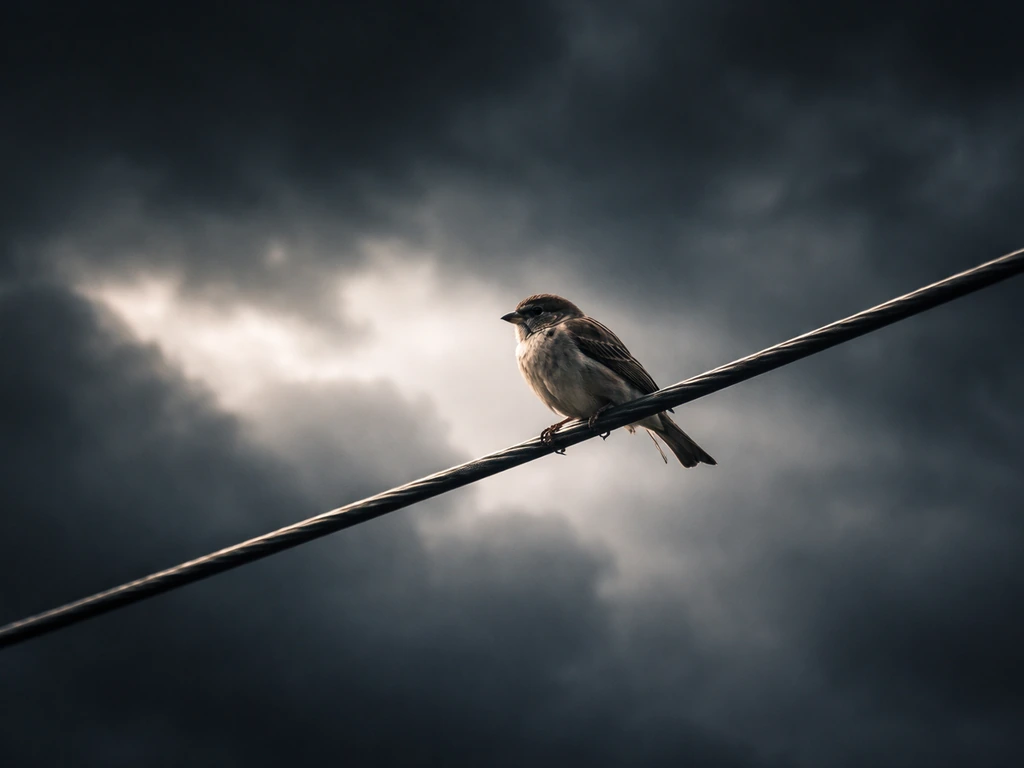
The phrase also resonates with the broader theme of searching that appears in expressions like "bird on a wire," which captures a different kind of in-between feeling: not empty, but not committed, not settled. The phrase "like a bird on a wire" meaning is often used to describe a tense, in-between state, caught between stability and unrest like a bird on a wire meaning. Kafka's cage has a more architectural quality. It is not wavering; it is constructed and searching. That distinction makes it useful for describing situations where the form is fixed but the content is absent.
How to use it correctly in conversation or writing

If you want to use this phrase, the most important thing is to make clear which direction the metaphor is pointing. Are you the cage, or are you describing a cage? In some contexts, people use this line to refer to a "jail bird" feeling, meaning someone who seems trapped by their situation jail bird feeling. The first-person version ("I am a cage in search of a bird") is a personal admission of longing or incompleteness. The third-person version ("a cage went in search of a bird") works better as an observation about a system, an institution, or another person's situation.
In writing, the phrase works best when you leave it room to breathe. Do not over-explain it immediately after quoting it. The image does its own work if the reader has been given enough context to land in the right emotional space. If you are using it in an essay or an analysis, attribute it to Kafka and note that it comes from the Zürau Aphorisms, because sourcing it correctly prevents confusion and also adds weight. Kafka's biography and the circumstances under which he wrote the aphorisms (illness, isolation, existential reckoning) are part of why the line carries so much gravity.
In conversation, use it sparingly. It is a literary reference and works best with people who have some familiarity with Kafka or who are comfortable with metaphorical language. If you drop it into casual chat without context, you will likely need to explain it, which undercuts the resonance. A better approach in spoken conversation is to paraphrase: "It's like being a cage with no bird, everything is set up but the actual living part is missing."
Avoid using it to describe situations where the constraint is doing obvious harm to someone who is clearly trapped. That is more of a "bird in a cage" or "bird in a gilded cage" scenario. If you mean the more specific idea behind that “bird in a cage meaning” phrasing, use this as a comparison point for how trapped-but-present versions differ. Kafka's line is specifically about the cage's perspective and the cage's absence, not about a bird that is suffering inside one.
How to double-check meaning when it's quoted out of context
This aphorism circulates constantly on social media, poetry sites, and quote aggregators, often without any surrounding text. If you encounter it and are not sure how the person using it intends it, here is a practical approach to figuring it out.
- Check which version is being used. "I am a cage" is a personal, first-person statement. "A cage went in search of a bird" is more observational. That grammatical choice usually signals the author's intent.
- Look at what surrounds the quote. Is it accompanied by themes of grief, loneliness, longing, ambition, or systemic critique? Each of those contexts pulls the meaning in a slightly different direction.
- Search the Zürau Aphorisms directly. The full collection is short and publicly available in translation. Reading even a few entries around number 16 will give you a clearer sense of the existential weight Kafka was working with, which is different from the romantic-longing interpretation that often gets applied to it online.
- Check whether the person quoting it is attributing it. If they are attributing it to Kafka, they are likely using it in a literary or philosophical sense. If it appears unattributed or attributed to "unknown," the user may be applying it more loosely or emotionally.
- Ask yourself: is the cage the speaker, or is the cage something the speaker is describing? That single question usually resolves the intended meaning.
- When in doubt, look up Michael Wood's essay "Cage in Search of a Bird: Kafka's Worlds" published in the London Review of Books. It is one of the more rigorous explorations of the aphorism in an accessible critical format and will give you the scholarly grounding to interpret any variant correctly.
The phrase is genuinely rich enough to sustain multiple readings, which is what makes it enduring. Whether you take it as a meditation on longing, a critique of empty systems, or a personal confession of incompleteness, you are not wrong. What matters is that you understand which reading you are working with, and why, before you apply it or pass it along.
FAQ
Does “I am a cage in search of a bird” mean the same thing as “a cage went in search of a bird”?
Yes, but it changes the tone. The first-person form (“I am a cage…”) reads like self-diagnosis, personal vulnerability, and an internal confession. The third-person form (“a cage went…”) reads like an external observation, fable-like and slightly more unsettling, because the “searching” feels like an event happening in the world rather than an inner state.
Can I use this phrase to describe someone being trapped in a bad situation?
It is usually a mismatch. Kafka’s image centers on an absent living element, the emptiness inside the structure. If the person is clearly present and trapped, readers will expect the more standard “bird in a cage” type wording, where the bird suffers inside the constraint rather than the constraint itself moving toward meaning.
How do I know whether to interpret the phrase as personal longing or as a critique of systems?
Make the “direction” explicit in your context. If you mean longing, connect it to missing fulfillment, for example “the routine is set but the spark is gone.” If you mean a critique of systems, connect it to institutions designed to produce meaning but failing to deliver the actual living outcome. Without that, people may assume you mean romance or sadness only.
Is the meaning mainly about loneliness or heartbreak?
Avoid the common mistake of treating it as purely romantic loneliness. The line can point to existential emptiness, spiritual or moral questioning, or the absurdity of purpose without substance. If you want to keep it emotionally honest, frame it around “apparatus without animating life,” not just “I feel lonely.”
Is the cage supposed to be the victim, the aggressor, or both?
In many readings, the “cage” is the one doing the searching, so it can feel like control and incompletion rolled into one. The ambiguity is intentional, so you can lean either way, victim or aggressor, but you should signal your choice. For a self-directed meaning, emphasize helplessness. For a systems-directed meaning, emphasize compulsion.
What should the “bird” represent in real-life examples?
You can, but do it carefully. The bird is typically the living, free, voice-like element, so if you map the bird to something that is not “freedom or animating life” (for example, a purely material reward), the metaphor can lose its sharpness. A safer match is something like purpose, truth, creativity, love, or self-expression.
Do I need to attribute it to Kafka every time I use it?
If you are quoting or paraphrasing, don’t assume it is safe to use without context. The phrase travels standalone online, so readers might miss that it is originally from the Zürau Aphorisms and that translation differences can affect tone. In longer essays, attribution and translation choice usually prevent the “wait, is this first-person or not?” confusion.
What’s the best way to introduce the quote so people get the intended meaning?
Yes, and it is the quickest way to fix confusion. If someone might misread it, add one plain sentence immediately after the quote, like “I have structure, but the living part is missing.” Then move on. Over-explaining the metaphor in multiple sentences tends to deflate its impact.
How is this phrase different from “bird in a gilded cage”?
Be cautious with “bird in a gilded cage” comparisons. That phrase usually involves a bird that is present but trapped by comfort or luxury, so the emotional physics are different. Kafka’s line flips the focus toward the structure’s emptiness and its own search, so only compare them if you clearly state which side is trapped or missing.
Can the phrase apply to people who are still busy and productive, but feel empty inside?
You can use it to describe momentum that goes nowhere. For example, when someone keeps doing the same disciplined steps for a goal that no longer feels alive, the “apparatus” stays in motion while the “bird” (meaning, desire, or fit) is absent. This keeps the meaning aligned with “structure searching without fulfillment,” not just “stuck.”
Next Article
Like a Bird on a Wire Meaning: Origin, Examples, and Usage
Meaning of like a bird on a wire and a bird on the wire, with origin, context cues, examples, and usage tips.