Finding a broken bird egg usually means one of a few things: a predator got to the nest, the egg fell or was pushed out, it failed to develop and the parent removed it, or a storm knocked things around. Symbolically, across folklore and spiritual traditions, a broken egg tends to represent loss, disrupted beginnings, or a cycle that didn't complete as expected. Neither meaning is fixed. What it actually means for you depends on where you found it, what condition the nest is in, and whether you're asking a practical question or a symbolic one.
Finding a Broken Bird Egg Meaning: Real and Symbolic

Marcus Winters
28 Jun 2026
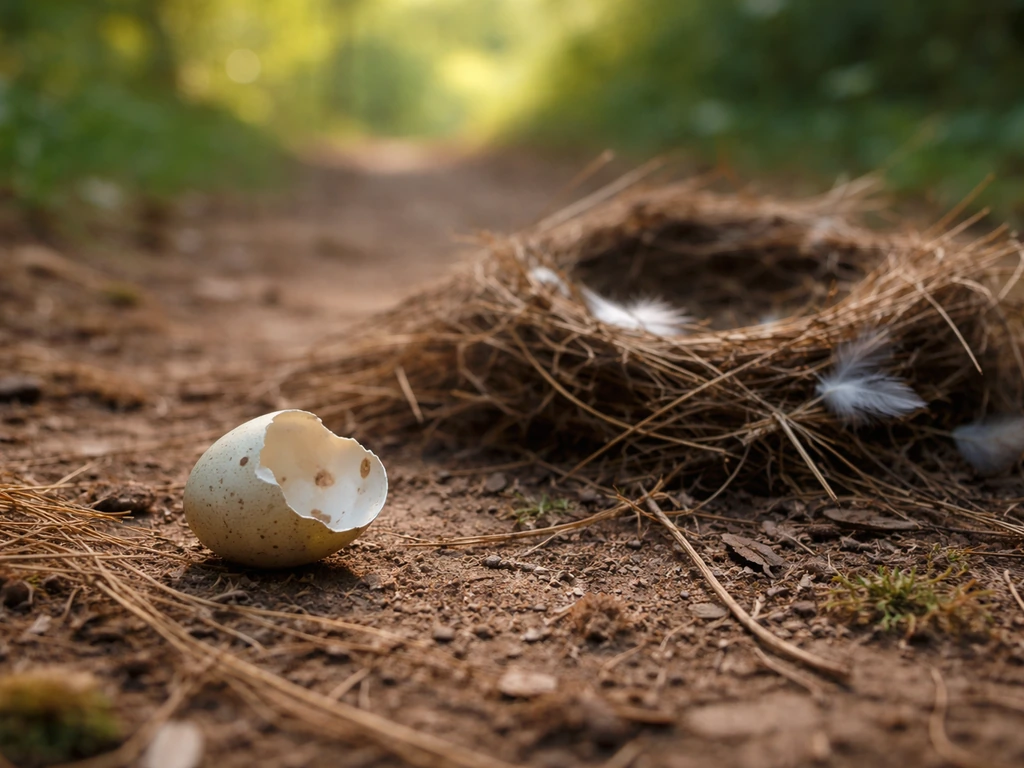
What finding a broken bird egg usually means in real life
Before you read anything spiritual into it, it helps to understand what typically causes a bird egg to end up cracked or broken. An empty bird nest can have its own symbolism too, often tied to absence, loss, or a transition that has already moved on empty bird nest meaning. There are really four main scenarios, and each one tells a slightly different story about what's happening at that nest.
- Predation: A snake, raccoon, crow, or jay raided the nest. You'll often see a cleanly cracked or punctured shell, sometimes emptied out. The nest may look disturbed or partially destroyed.
- Ejection by the parent: Birds sometimes push out an infertile egg, a dead embryo, or a parasitized egg. This is instinctive housekeeping, not abandonment of the whole nest.
- Weather damage: Heavy rain, wind, or a storm can knock a nest loose or crack eggs directly. Research has confirmed that short, intense rainfall events are a documented cause of nest failure.
- Brood parasitism aftermath: Species like cowbirds lay eggs in other birds' nests. The host bird may crack and remove those foreign eggs, which explains broken shells that appear without obvious predator signs.
- Accidental human or animal disturbance: A lawn mower, a curious pet, or even someone walking too close can dislodge eggs from low-built nests.
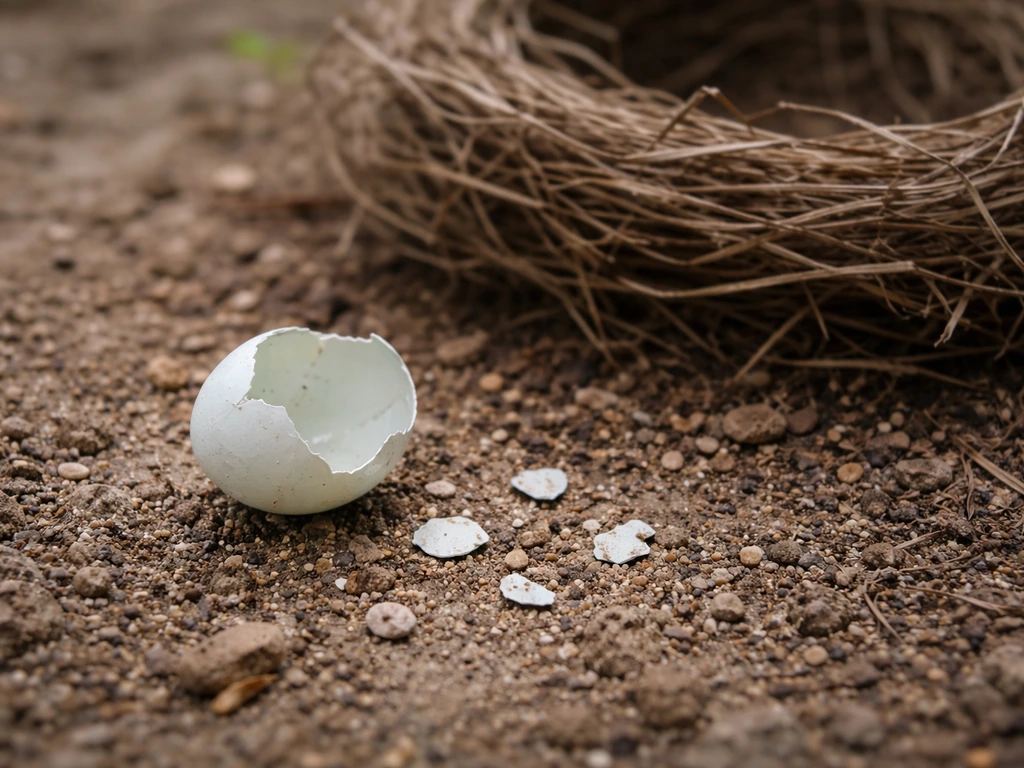
One thing that trips people up: a broken eggshell on the ground near a nest isn't always bad news. Sometimes it's a hatching shell, which parents will often carry away from the nest to avoid attracting predators. A thin, pale shell fragment with a clean edge is often the remnant of a successful hatch, not a failure.
Common symbolic meanings in folklore and spirituality
In symbolic traditions, an egg represents potential, new life, and beginnings that haven't yet been realized. When that egg is broken before it hatches, most cultural frameworks interpret it as potential that was cut short. That's the thread running through most folklore interpretations, though the tone ranges from cautionary to transformative depending on the tradition.
In general folk belief, stumbling across a broken egg, especially unexpectedly, has historically been read as a sign of disruption or a warning. Some European traditions associate it with bad luck or an omen that something planned won't come to fruition. In certain belief systems, particularly those that treat eggs as symbols of the soul or spiritual potential, a cracked egg signals that protection has been broken and something vulnerable is now exposed.
But there's a more nuanced reading that appears in transformation-oriented spiritual frameworks: the broken shell isn't only loss. It can also mean release, the necessary breaking of an old container so something new can emerge. This interpretation frames the broken egg as a liminal symbol, sitting between an ending and a beginning. Think of it as the symbolic equivalent of a chrysalis splitting open.
The specific bird species matters in many traditions too. A broken robin egg (that familiar vivid blue) might be read through the lens of robin symbolism, which in Western folklore often centers on renewal and the coming of spring. A broken raven or crow egg would carry entirely different connotations in traditions that treat those birds as messengers or omens. If you know what kind of bird laid the egg, that context genuinely shifts the symbolic interpretation. In some traditions, the hatch bird meaning connects the broken shell to a transition into something newly begun.
It's also worth noting that finding a bird egg (intact) carries its own symbolic meaning in many traditions, often associated with hope, fertility, and potential. The cracked or broken version is essentially that same symbol under stress. If you're interested in the broader symbolism around discovering eggs generally, that's a useful parallel to explore.
Context checks: location, bird species, and nest condition
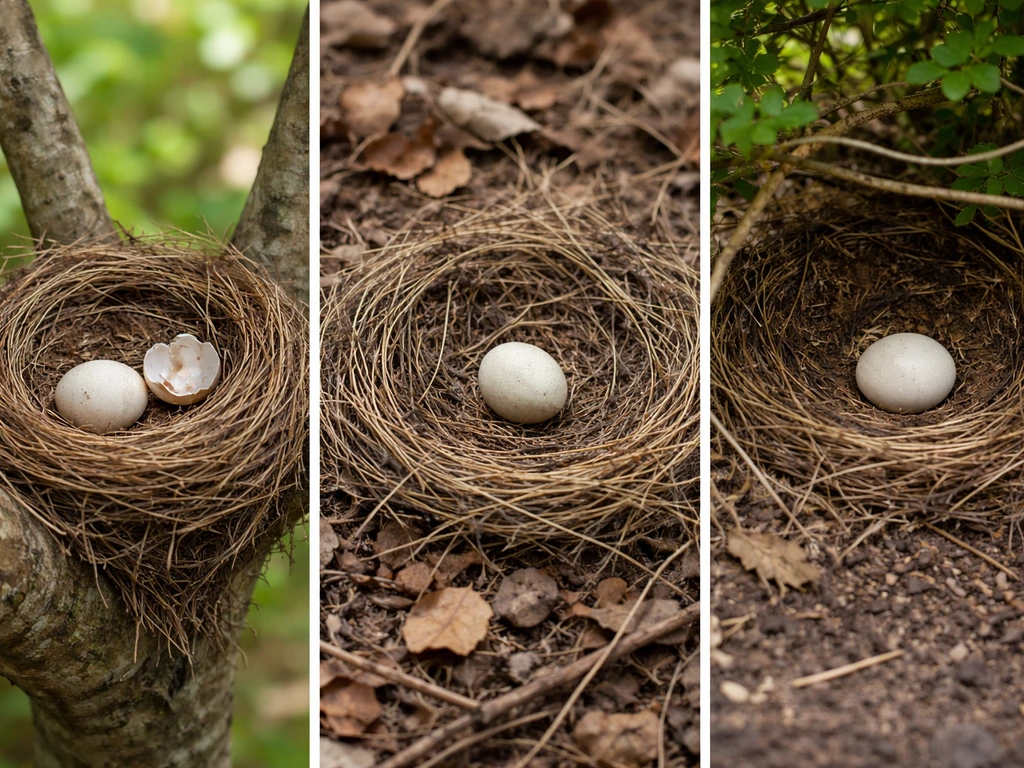
Where and how you found the egg changes what it probably means, practically and symbolically. Run through these context questions before drawing any conclusions.
| What you found | Most likely explanation | Symbolic read (if relevant) |
|---|---|---|
| Cracked shell on ground below an active nest | Storm damage, predator strike, or ejection by parent | Disruption near the source; something close to you is under pressure |
| Empty, punctured shell near disturbed nest | Predation (likely raccoon, snake, or crow) | External threat breaking something protected |
| Thin pale shell fragment near nest | Successful hatching; parent removed the shell | Positive sign: potential fully realized |
| Broken egg inside nest with remaining intact eggs | One egg failed; parent may continue incubating others | Partial loss, but continuation is still possible |
| Broken egg far from any visible nest | Dropped by a predator or carried by wind/animal | Disconnected from origin; meaning is less anchored |
Bird species identification also shapes what you should do next, not just what it means. Native migratory birds in the US are protected under the Migratory Bird Treaty Act (MBTA), which covers their nests and eggs. Non-native, introduced species like House Sparrows, European Starlings, and Rock Pigeons do not have the same legal protections. RSPB also notes that it is illegal to take or destroy the egg of any wild bird, and that wild birds’ nests and eggs are protected under the relevant UK law. Knowing which you're dealing with matters if you're wondering whether you're allowed to move anything.
Safe next steps: what to do right now
If you've just found a broken egg and there's still an active nest nearby with intact eggs or chicks, here's what to do in order.
- Step back and observe from a distance. Give yourself at least 10 to 15 feet of space. Watch whether a parent bird returns within 20 to 30 minutes before making any assumptions about abandonment.
- Assess the nest without touching it. Is it structurally intact? Are there other eggs or young inside? Is the nest still attached to its original position or has it fallen?
- If the nest has fallen but is otherwise intact, you can gently place it back in the same tree or shrub, as close to the original location as possible. The myth that human scent causes birds to abandon nests is largely false for most species.
- Leave the broken egg alone. If it's in or near the nest, the parent birds will manage it. If it's on the ground away from the nest and clearly non-viable (cracked open, contents dried out), it poses no risk to the remaining clutch.
- Reduce activity in the area. Don't mow, trim, or move objects near the nest until you're sure the nest cycle is complete.
- Mark the area mentally or with something low-key (a small stake a few feet away) so you don't accidentally disturb it again.
If the broken egg is isolated and there's no visible nest nearby, the most responsible action is simply to leave it. Do not pick it up. Do not attempt to incubate it or bring it indoors. A broken egg is not viable, and handling wild bird materials without a federal permit is legally restricted under the MBTA.
What not to do
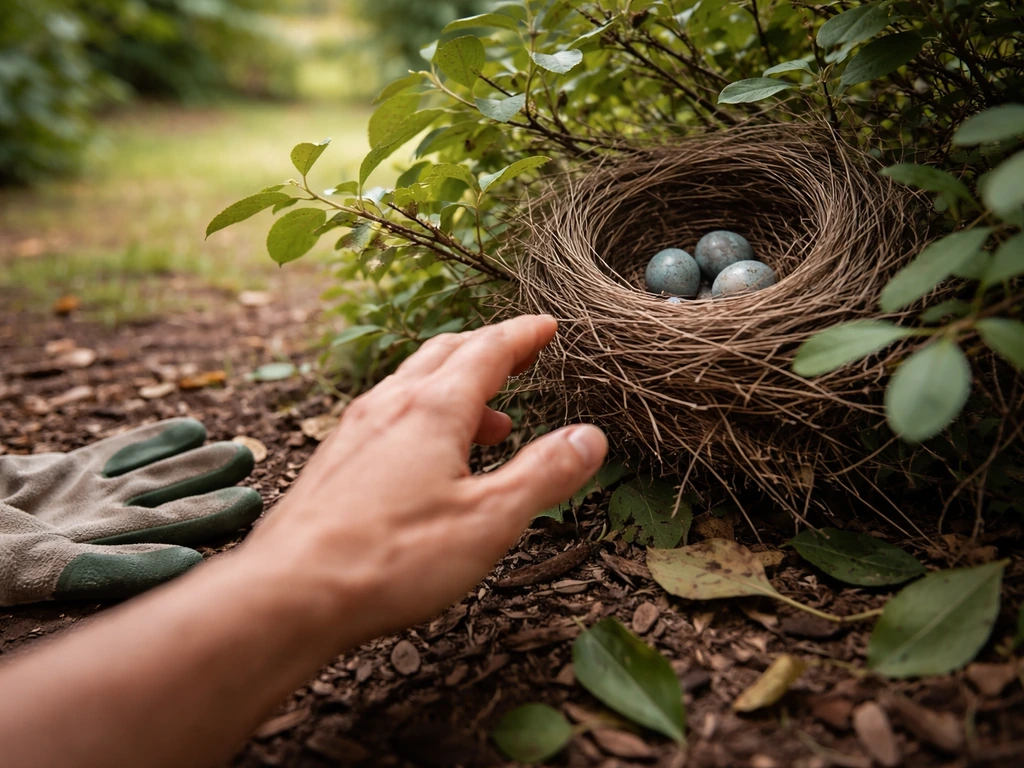
This is where a lot of well-meaning people go wrong. The instinct to help is good, but some common actions can make things significantly worse for the nest and put you at legal or health risk.
- Don't repeatedly check the nest. Frequent visits create a trail that predators notice and follow. There's documented evidence that predators watch humans find nests and return after people leave.
- Don't touch or collect the broken eggshell as a keepsake. Possessing wild bird eggs or nests without authorization is illegal under the MBTA in the US and under the Wildlife and Countryside Act 1981 in the UK.
- Don't try to incubate a broken egg yourself. A cracked egg cannot develop successfully, and attempting to incubate it creates health and hygiene risks.
- Don't touch the shell with bare hands if you must handle it. Wild bird materials can carry pathogens. The CDC advises against handling wild bird remains or contaminated surfaces. Use gloves if cleanup is necessary.
- Don't assume the nest is abandoned just because you don't see the parent. Many birds, especially when incubating, will stay off the nest for stretches of time. Activity isn't always visible.
- Don't move the nest to a completely different location. Relocating it more than a few feet from its original spot significantly reduces the chance of the parents returning to it.
When to contact wildlife experts and local guidance
Most broken egg situations don't require expert intervention. But a few scenarios genuinely do, and it's worth knowing when to make that call.
Contact a licensed wildlife rehabilitator if: the nest has collapsed and contains live chicks that have fallen to the ground; there's a live bird in or near the nest that shows signs of injury (bleeding, inability to stand, a visibly broken wing); or you suspect the parent has been killed (you find a deceased adult bird nearby). In the US, you can find your nearest licensed rehabilitator through the National Wildlife Rehabilitators Association or the Wildlife Rehabilitator Directory. Audubon also recommends contacting local animal services if a rehabilitator isn't immediately reachable.
For questions about what species is involved or whether a nest is protected, your state's wildlife agency is a reliable first call. In the UK, the RSPB provides direct guidance and a helpline. If you're unsure whether a bird is a protected migratory species or an introduced non-native species (which changes your legal obligations), your state or local wildlife department can tell you quickly.
If the broken egg is part of a larger nest disturbance in a location that creates a genuine hazard (say, a nest built inside HVAC equipment or a commercial building), the USFWS issues special permits for nest removal in those cases. Don't handle that situation without proper authorization.
How to find the right personal interpretation without over-reading it
If you're drawn to the symbolic side of this, that's completely valid. People have been reading meaning into bird behavior and eggs for thousands of years across nearly every culture. But one thing worth keeping in mind: there is no single universal meaning. What a broken bird egg symbolizes depends heavily on your own cultural background, what the egg means to you personally, the specific circumstances you found it in, and honestly, what resonates when you sit with it. The oven bird meaning is another example of how bird symbolism people share online can shape personal interpretation.
A useful way to approach it: start with the literal context (what probably caused the break, based on what you saw), then ask whether that cause maps to anything happening in your life. If you are specifically asking about the egg bound bird meaning, start by checking whether the egg looked fully formed and whether there is an active nest nearby. A broken egg caused by a storm might feel meaningful if you're in a turbulent period. One ejected by the parent might resonate if you're releasing something that wasn't working. A hatching shell misread as a broken one could actually be a sign of something completing, not failing.
The trap to avoid is forcing a dramatic interpretation onto something that might just be a raccoon raiding a nest on a Tuesday. Symbolism works best when it emerges naturally from genuine reflection, not when it's imported wholesale from a generalized list of omens. Use the folklore as a vocabulary for what you're feeling, not as a verdict.
It's also worth distinguishing this from related bird egg idioms in common usage. Phrases like 'walking on eggshells' have a well-established figurative meaning (navigating a tense or fragile situation carefully) that has nothing to do with literal nest symbolism. Expressions around hatching (as in 'hatch a plan') and empty nests carry their own distinct meanings in language and folklore. Finding a broken egg in the physical world sits in a different category from those idiomatic expressions, even though the imagery overlaps.
Ultimately, the most grounded approach is to handle the practical side first (observe, don't touch, protect the area, call a rehabilitator if needed), then give yourself space to sit with whatever meaning feels true. You don't have to choose between the biological explanation and the symbolic one. Both can be real at the same time.
FAQ
If I find a broken bird egg, can I assume the bird was killed or that something is “bad luck” for sure?
Not necessarily. Predators, storms, or normal ejection can crack eggs, and many eggs are removed because they never developed. Treat the event as information about what likely happened at that nest first, then decide whether any symbolism fits your situation, instead of assuming a fixed omen.
How can I tell the difference between a hatching shell and a truly failed egg?
Look for a shell fragment that’s thin and pale with a fairly clean, hatched-looking edge, and check whether there’s active movement nearby. If you see intact eggs or chicks still in the nest, that strongly suggests the broken piece may be after-hatch material rather than a sign that the clutch failed.
Should I move the nest or “save” the egg if it seems abandoned?
Usually no. Even if the nest appears abandoned, you can’t assume it’s safe to touch, and moving eggs or nests can be illegal for protected migratory species. Instead, observe from a distance, keep pets away, and only contact a wildlife rehabilitator or local wildlife agency if there are clear signs of injury, collapse, or a hazard.
What if the egg is in my yard, and I’m worried my dog or cat will eat it?
Keep animals indoors or restrained and create distance around the area without picking up the shell. Your goal is to protect the nest and prevent disturbance, while avoiding handling wild bird remains that could create legal or health issues.
Can I pick up the shell to confirm species or to keep as a keepsake?
It’s best not to. Besides the legal restrictions that can apply to bird eggs and materials, handling can also destroy evidence you might need to assess what happened. If you want to identify the species, take photos from a safe distance instead, then contact a local wildlife expert if you’re unsure.
What should I do if I find multiple broken eggs at once?
Multiple breaks often point to a single event like repeated predation attempts, a storm, or a disturbance to the nest site, not an isolated “omen.” The practical next step is to check whether the nest is still active, and if there’s collapse, bleeding, or injured adults, contact a rehabilitator.
Does it matter what time of year I find the broken egg?
Yes. In many regions, egg-laying and hatching occur during specific seasonal windows, so timing helps you judge whether you’re likely seeing early clutch loss, a mid-season hatch, or late-season nesting failure. If you know the season for local species, you can better interpret whether it’s plausibly a hatch remnant versus an abandoned nest.
If I want the symbolic meaning, how do I avoid misreading a normal biological event?
Use a two-step check: first, list the most likely practical cause based on what you see (intact nest nearby, nest placement, predator signs, storm debris). Then ask whether the emotional theme you feel matches that cause. This prevents you from forcing an interpretation onto what may simply be a common nesting outcome.
Are there situations where I must contact someone even if the egg looks old or dry?
Yes. If the nest is collapsed with live chicks on the ground, if you see an injured adult, or if there’s evidence a parent was killed nearby, you should contact a licensed rehabilitator or local animal services even if the broken egg itself seems old. Those scenarios can involve immediate animal welfare needs.
I suspect it might be an invasive or introduced species. Does that change what I can do?
It can change legal obligations, but you still should not handle the nest or eggs until you’re sure. Start by contacting your state or local wildlife agency and share photos and location details, then follow their guidance for the specific species involved.
Next Article
Egg Bound Bird Meaning: Signs, Causes, and What to Do Now
Learn egg bound bird meaning, signs and immediate steps, plus causes and when to get urgent avian vet care